

The primary cause of high UK energy bills is imported natural gas, not renewable energy. This single fact reshapes nearly everything most people assume about the ongoing energy crisis. 1
Over 50% of the UK's electricity now comes from renewable sources. Yet Britain still carries some of the highest electricity prices in Europe.
That apparent contradiction has a clear, evidence-based explanation. Gas-fired power plants set the wholesale price of electricity roughly 90% of the time in the UK, compared to just over 40% across the EU. When global gas prices spike, electricity bills follow, regardless of how much cheap wind or solar power flows through the grid.
High bills trace directly to imported natural gas prices and the cost of upgrading Britain's electricity infrastructure. Wind farms and solar panels are not the primary driver of rising energy costs. 3
This analysis examines the principal forces behind rising household energy bills. It covers gas price volatility, import dependency, infrastructure investment, and the measurable impact of international events on UK domestic costs.
Readers will leave with a clear, evidence-based understanding of what actually drives their monthly bill and what a genuine long-term solution looks like. 2
Key Takeaways
- Gas price volatility, not renewables, drives UK energy bills high, with gas setting electricity prices roughly 90% of the time compared to the EU average of just over 40%.
- Renewable energy contributes only 13% to household bills at £236 yearly, whilst removing renewable subsidies would cut bills by less than 1%.
- The UK imports roughly 40% of natural gas, making household bills vulnerable to international supply disruptions, geopolitical tensions, and global market price swings.
- Infrastructure upgrades and grid modernisation, not clean energy itself, carry real blame for rising energy bills across Great Britain and consumer households.
- Transitioning to renewable energy will lower household costs over time, enhance energy security, reduce climate emissions, and create thousands of jobs across UK communities nationwide.
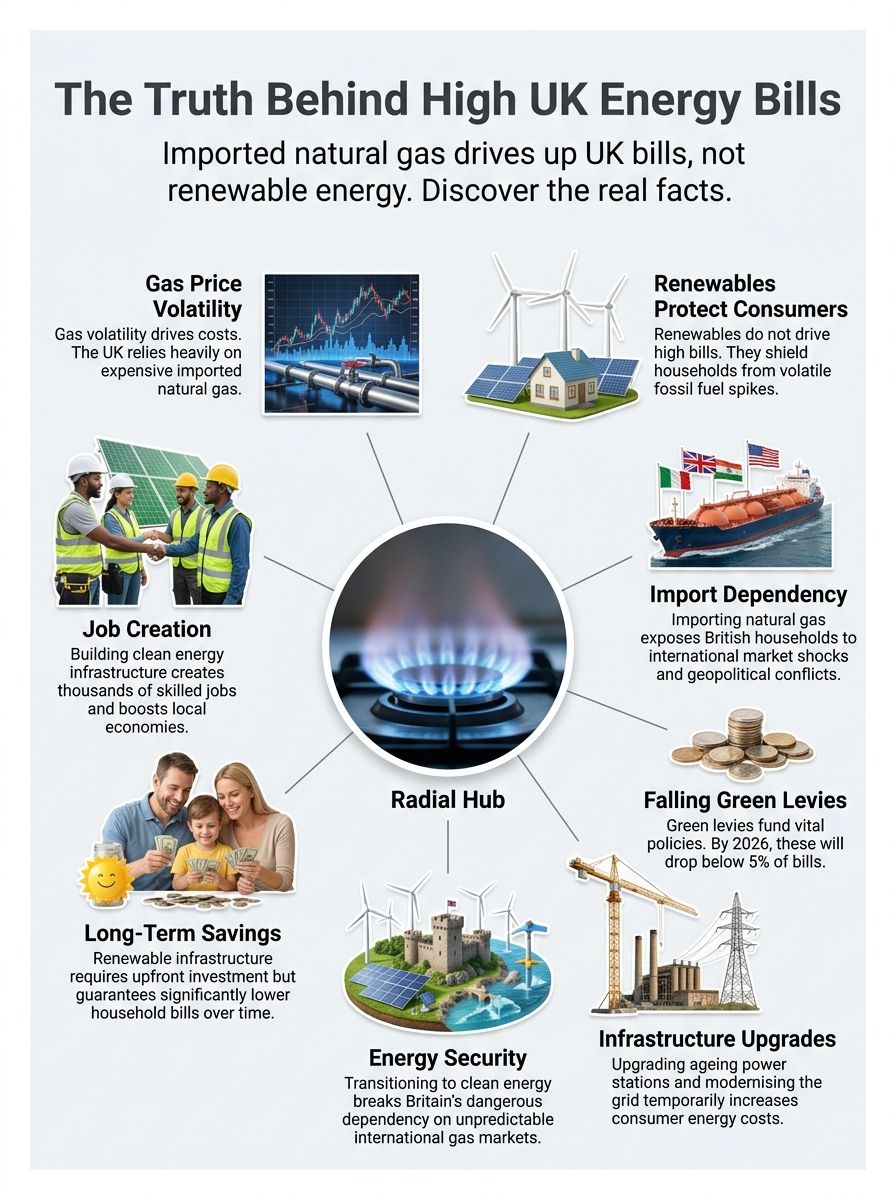
Main factors driving high UK energy prices

Several key factors push UK energy bills higher. Understanding each one helps explain the numbers on your monthly statement.
| Factor | Impact on Your Bill | Key Details |
|---|---|---|
| Gas Price Volatility | Primary driver of high costs | Gas prices spiked sharply following Russia's invasion of Ukraine. The UK's reliance on gas drives wholesale electricity prices roughly 90% of the time, compared to the EU average of just over 40%. 1 British households feel these price swings far more sharply than their European neighbours. |
| Wholesale Electricity Costs | Approximately 40% of your bill | These costs reflect what energy suppliers pay to purchase power. When gas prices climb, electricity generation becomes more expensive. Your bill climbs in response, even if your consumption stays the same. |
| Heating Requirements | Around 50% of average household bills | Most UK homes rely on gas for heating. Winter demand pushes prices higher across the market. Heating costs form the largest single portion of your total energy spending each year. |
| Import Dependency | Increases vulnerability to global shocks | The UK imports significant quantities of natural gas. International supply disruptions, geopolitical tensions, and supply chain issues directly affect what you pay. Dependence on imports leaves British energy costs exposed to forces beyond domestic control. |
| Market Shock Lingering Effects | Bills remain above pre-2021 levels | The 2022 market shock caused lasting damage to energy pricing structures. Even as some pressures ease, bills have not returned to previous levels. Network costs have increased, keeping expenses elevated for households nationwide. |
| Network Infrastructure Costs | Growing portion of energy bills | Maintaining and upgrading the electricity grid requires substantial investment. These infrastructure expenses get passed to consumers through their bills. Modernising the network to support renewable energy integration adds to these costs in the short term. |
| Green and Social Levies | Currently embedded in bills, reducing soon | These levies fund government energy policies and renewable investments. By April 2026, social and green levies will decrease to less than 5% of your bill. This reduction will provide measurable financial relief for households in the coming years. |
| Renewable Energy Investment | Currently £236 per year (13% of bills) | Renewable energy contributes approximately 13% of the average household energy bill. This investment builds long-term energy security. Over time, expanding renewable capacity reduces reliance on volatile gas markets and stabilises costs. |
Your energy bills reflect a combination of market forces, geopolitical events, and infrastructure needs. 2 Gas prices remain the single most important factor, shaping what you pay each month. The path forward lies in moving away from gas dependency and building cleaner, more stable domestic energy sources.

Why do gas prices affect UK energy bills so much?
Gas prices dominate UK energy bills because wholesale power prices track natural gas costs directly. Gas-fired power plants generate a significant share of Britain's electricity, and the UK's heavy reliance on imported natural gas means that global market price swings hit household bills hard.
Any supply disruption or international price spike pushes wholesale prices upward, making energy costs vulnerable to events entirely outside Britain's control.
How does the UK's import dependency impact energy costs?
The UK imports roughly 40% of its natural gas, which means energy bills move with global market prices rather than staying stable at home. According to a March 2026 UK Government Energy Trends report, the country had a net energy import dependency of 43.5% in 2025, with Norway supplying nearly 70% of imported natural gas via pipelines and the USA supplying 76% of imported Liquefied Natural Gas (LNG). This import dependency creates a serious problem. When international supply tightens or conflicts erupt, British households feel the impact immediately.
The 2022 Ukraine war proved this point dramatically, forcing the government to spend £44 billion in subsidies just to keep bills manageable. The UK competes with other nations for LNG on the world market, which intensifies price pressure whenever global demand surges.
Even gas produced in the North Sea gets priced according to international rates, not cheaper domestic costs. Increasing North Sea extraction would not shield households from price spikes driven by global events or supply shortages.
Energy security depends on breaking free from imported gas vulnerability, not on drilling more at home.
The energy market reform debate centres on this exact issue. Wholesale power prices depend heavily on what happens thousands of miles away, whether in the Middle East, Lithuania, or anywhere else supplying energy to Europe.
The National Energy System Operator and energy policy experts recognise that import dependency traps the UK in a cycle of rising costs. The energy price cap and energy price guarantee exist precisely to shield consumers from the worst shocks, yet they cost taxpayers billions each year.
Countries like Denmark and Germany have shown that renewable investment reduces reliance on imported fuels and stabilises energy costs over time. Building homegrown clean energy infrastructure creates jobs, enhances energy security, and cuts exposure to volatile international markets. The Labour government and energy transition advocates understand this argument clearly.
How do renewables and fossil fuels influence UK energy bills?
Renewable energy sources and fossil fuels shape your energy bills in very different ways. Each pulls the price in opposite directions. Understanding how these two power types compete on the grid helps explain why your bills look the way they do right now.
Do renewables increase energy bills in the UK?
Renewables do not drive up your energy bills. Gas price volatility does. 1 Energy experts from Ember and Carbon Brief have confirmed this repeatedly.
Your household bill includes about £236 per year from renewable energy sources, representing roughly 13% of your total costs. The real culprit behind rising bills is the unpredictable price of imported natural gas.
Marginal pricing means that when gas prices spike, electricity prices follow suit, even though renewables generate power at much lower costs. As clarified in a March 2026 market explainer by Energy UK, even though cheap renewables are deployed first on the grid, the final market price is set by the most expensive flexible generator needed to meet peak demand. That generator is almost always a gas plant. This is why the cheap generation cost of renewables does not automatically translate into lower consumer bills.
Under 20% of current social and green levies on your bill actually support new renewable energy sources. By April 2026, these levies will drop to less than 5% anyway, so removing renewable subsidies entirely would cut your bill by less than 1%. 3
Energy Networks Association data shows that renewable energy sources receive priority in the merit order for electricity generation, meaning they get dispatched first because they cost less to run. This system protects consumers from expensive fossil fuel price swings. Octopus Energy and other suppliers must pass on gas costs to customers, but renewables shield households from the worst price increases.
The transition to clean energy will lower your costs over time compared to a continued reliance on fossil fuels. Investment in renewable infrastructure carries a cost today, but energy security and reduced climate emissions create long-term savings for everyone. Fuel poverty decreases as the UK shifts away from gas dependency, particularly for vulnerable households that struggle most with energy bills.
Why are infrastructure upgrades blamed, not renewables?
Infrastructure upgrades carry the real blame for rising energy bills, not renewable energy itself. The UK's aging power stations, including nuclear and coal-fired plants, require replacement or significant upgrades to keep the lights on.
These massive projects drain money from consumer bills because government policies funnel investment costs directly to households. The marginal pricing system, which heavily relies on gas prices, obscures the true picture and leads people to assume renewables are the culprit. 4 Experts from organisations like E3G and the UCL Institute for Sustainable Resources highlight that policy reforms must address infrastructure costs rather than focusing solely on renewables. According to Ofgem's February 2026 price cap announcement, network costs for households officially increased by £66 a year under the current RIIO-3 price control framework. This is a direct, documented addition to bills that has nothing to do with clean energy generation.
The real issue sits with how the UK funds these upgrades, not with clean energy itself.
Infrastructure investment for effective renewable energy use, such as energy storage systems, does add costs to bills. Cornwall Insight analysis shows that subsidies for low-carbon projects form part of the financial burden on consumers, yet this diverts blame away from the true source of expense.
David Toke and other energy experts stress that the UK must distinguish between costs tied to ageing infrastructure and costs linked to the energy transition. Consumer bills cover government energy policies that support the shift away from fossil fuels, creating a picture that confuses households about what actually drives their costs.
The transition to renewable energy requires upfront investment, but this spending builds long-term energy security and reduces the country's dangerous dependency on imported natural gas, which remains vulnerable to international volatility and price shocks. 1
How is investment in new energy sources funded?
Your energy bills fund government energy policies and infrastructure upgrades across Great Britain. Consumer payments directly support the energy transition, covering everything from grid modernisation to renewable installations that shape the country's net zero future.
Why do consumer bills cover government energy policies?
Government policies on energy, climate action, and social support get paid for through your energy bills rather than general taxation. About 13% of what you pay each month covers these costs, including green levies that fund environmental schemes and social programmes to help vulnerable households. 1
The Tony Blair Institute and energy experts have long debated this approach. Spreading these costs across all consumers creates an unfair burden, particularly for those struggling most with bills.
Energy policy costs should not fall heaviest on those least able to afford them.
The good news is that after April 2026, these levies will drop to less than 5% of your bill, saving households around £150 annually. This shift reflects a growing recognition that funding net zero ambitions and social support through general taxation makes far more sense than loading costs onto energy bills.
Less than 20% of green levies actually fund new renewable energy projects. Most cover other environmental and social costs. 3 Removing renewable subsidies entirely would cut your bill by less than 1%, which confirms that renewables themselves are not the main driver of high prices.
Infrastructure upgrades needed across Great Britain to support the energy transition carry substantial costs that get passed to consumers. Energy efficiency programmes, grid modernisation, and support for low-income households all appear on your bill.
Keir Starmer's government recognises this problem, which explains why the policy framework is shifting so that government priorities get funded through broader tax revenue. Your energy bill will then reflect actual supply costs more accurately.
What infrastructure costs are linked to renewables?
Shifting to renewable energy demands real money spent on new infrastructure, and these costs find their way into your energy bills today. 4 Understanding what drives these expenses helps clarify why the transition requires patience and upfront investment.
| Infrastructure Investment Type | What It Covers | Why It Matters for Your Bills |
|---|---|---|
| Renewable Energy Infrastructure | Building wind farms, solar installations, and hydroelectric facilities across the country. Key investment in renewable energy infrastructure is essential for increasing renewables' electricity supply share. | Developers need substantial capital upfront. Energy suppliers pass these costs to consumers through electricity charges. |
| Energy Storage Technologies | Installing pumped hydropower systems and flow batteries to store excess renewable energy. Energy storage technologies require significant infrastructure investment to support renewables. | Storage keeps renewable power available when the sun is not shining or wind is not blowing. These systems cost millions to install and maintain. |
| Grid Upgrades and Modernisation | Strengthening power lines, upgrading transformers, and installing smart metres. Infrastructure investment is required to adapt to increased renewable generation, including grid upgrades. | The electricity network must handle power flowing from many renewable sources simultaneously. Modernising the grid adds to overall electricity bills. |
| Localised Generation and Demand Management | Building infrastructure to manage electricity produced and used in specific regions. New infrastructure investments are essential for managing localised generation and demand dynamics. | Different areas produce and consume different amounts of renewable power. Managing this requires new technology and equipment. |
| Electricity Market Reforms | Implementing pricing zones and other market changes to support renewables. Proposed reforms to the electricity market, such as pricing zones, may involve infrastructure costs. | Market restructuring requires new systems and administration. These expenses factor into consumer bills. |
| Energy Market Reshaping | Potentially nationalising gas plants and setting fixed-price contracts for energy security. Nationalising gas plants and implementing fixed-price contracts require upfront infrastructure investment to reshape the energy market. | Restructuring the entire energy market involves buying, upgrading, and repurposing facilities. Consumers shoulder these transition costs. |
These investments cost real money right now, yet they create long-term savings for everyone. Building renewable capacity today means lower fuel costs and greater energy independence tomorrow. That independence protects households from the volatile international gas markets and price shocks that currently squeeze budgets across Britain.
How do international events affect UK gas prices?
International events shape UK gas prices in ways that touch your energy bill every month. Geopolitical tensions, supply disruptions from major producers, and trade conflicts create price spikes that ripple through British households, pushing energy costs higher with very little warning.
What caused the recent 30% spike in gas prices?
Several major events pushed gas prices up by 30% in recent times, and the cascade began well before current pressures emerged. The invasion of Ukraine on 24 February 2022 triggered the most severe wholesale gas price spike the UK had seen in decades. 5 Russia's actions under Vladimir Putin disrupted global energy supplies, sending shockwaves through markets across Europe and beyond. The ongoing conflict created real uncertainty about future supply chains, forcing energy companies to pay far more for gas reserves.
Middle Eastern conflicts added further pressure to prices, creating additional supply concerns that rippled across the entire energy market. According to a March 2026 market report by Morningstar UK, wholesale UK gas prices surged from an average of 83 pence per therm to peaks of 174 pence per therm by mid-March 2026, driven by disruptions to LNG flows from the region. That more than doubling in the cost of gas fed directly into household electricity bills.
The UK's heavy reliance on imported gas made the country particularly vulnerable to these price shocks. Gas prices set the cost of electricity roughly 90% of the time in the UK, which meant that any spike in gas costs immediately affected what people paid for power.
This dependency on foreign energy sources, rather than homegrown renewables, exposed British consumers to international market swings beyond their control. Unlike Spain and other nations pushing forward with renewable investment, Britain remained heavily exposed to volatile global markets.
These market dynamics, driven by geopolitical tensions and supply shortages, transformed energy bills into a direct reflection of world events rather than stable, predictable costs.
Why is the UK vulnerable to imported natural gas volatility?
The UK faces serious exposure to imported gas price swings because the nation relies heavily on overseas suppliers. Domestic production does not shield British households from global market turbulence.
The UK is a net gas importer, meaning the country buys more gas from abroad than it produces at home. Even if domestic extraction from the North Sea were increased, this would not resolve import dependency. Domestic gas production remains subject to international market price fluctuations, just as imported supplies are. The marginal pricing system means global gas price changes hit domestic energy bills immediately.
International supply shortages, such as those caused by the Russia-Ukraine conflict, increase market volatility rapidly. UK households have not seen bills return to pre-2021 levels because international market instability persists.
The UK's heavy reliance on gas for heating and electricity generation makes the country uniquely exposed among European nations. 6 As noted in an April 2026 analysis by the Institute for Government, the UK also has significantly less physical gas storage capacity than European neighbours like France or Germany. This lack of a storage buffer means Britain cannot ride out short-term price spikes the way other countries can. When prices rise, the impact reaches households almost immediately.
Gas price spikes ripple through the economy quickly because so much of Britain's power comes from this single fuel source. Political leaders including Miliband recognise that this vulnerability threatens long-term energy security.
Moving away from this dependency requires investment in cleaner energy sources. The Commonwealth nations have grappled with similar energy independence challenges, but the UK's exposure is particularly acute given its current market structure.
Conclusion
The evidence is clear. Volatile imported gas prices, not renewable energy, are the primary cause of high UK energy bills. Britain's deep exposure to international gas markets, combined with insufficient domestic storage and ageing infrastructure, has created the conditions for persistent high costs.
Urgency for the UK to maintain leadership in the transition to clean energy
Maintaining Britain's Clean Energy Leadership
Britain faces a critical moment in the global energy race. Global investment in renewables now exceeds fossil fuel spending by a factor of two, and nations across the world are accelerating clean energy projects at pace.
The UK has already generated over 50% of its electricity from renewable sources, matching Europe's achievements and demonstrating real progress. Yet this leadership position requires continued policy support to remain strong.
Falling behind now would cost Britain dearly. Other countries are capturing the growth opportunities and jobs that clean energy creates. Delay risks surrendering the UK's competitive advantage in this expanding sector.
Transitioning to renewable energy offers multiple rewards beyond environmental protection.
- Lower energy costs as renewable electricity becomes the cheapest form of new generation available today.
- Stronger energy security as Britain reduces dependence on imported natural gas and volatile global markets.
- Job creation and economic growth through investment in clean energy infrastructure and technology.
- Reduced greenhouse gas emissions that protect future generations from environmental damage.
The transition is not a distant prospect. It demands action now to secure these benefits and maintain Britain's standing as a clean energy leader.
Transition to renewable energy to decrease gas dependency
Switching to renewable energy offers the UK a direct path away from the grip of volatile gas markets. Right now, the nation relies heavily on imported natural gas, which leaves households exposed to sudden price shocks from international events.
The UK aims to eliminate nearly all fossil fuels from electricity production by 2030, and this shift will cut dependency on imported gas significantly. 7 Renewable sources like wind and solar carry low generation costs once built, unlike gas prices that swing sharply based on global supply and demand.
By investing in wind farms, solar panels, and other clean energy infrastructure, the UK reduces how much gas it needs to import. This transition protects household bills from the kind of price spikes seen recently, which stem directly from gas dependency.
Energy security improves as the country shifts away from fossil fuels. Gas price volatility has been the main cause of recent energy bill increases, yet renewable sources offer far more predictable costs that remain stable over time. Communities that host wind and solar projects experience tangible benefits, as these installations generate electricity without the uncertainty tied to international markets. 6
The rapid roll-out of renewables is essential to shield the UK from future gas price shocks and to strengthen energy independence. In time, this shift will lower energy bills, enhance energy security, reduce climate emissions, and create job and growth opportunities across the nation.
Renewables will lower energy costs over time, enhance energy security, reduce climate emissions, and create job and growth opportunities
Renewable energy sources deliver real savings to households across the UK, transforming how the country powers its homes and businesses. 8 These clean technologies create benefits that extend well beyond lower bills.
- Renewable energy systems reduce household bills significantly as fossil fuel dependency decreases over time, delivering genuine financial relief to families struggling with energy costs.
- Wind and solar installations enhance energy security by cutting reliance on imported natural gas, protecting UK households from volatile international price spikes that damage household budgets.
- Clean energy infrastructure creates thousands of jobs in electric vehicle installation, heat pump deployment, and renewable maintenance across communities nationwide, boosting local economies.
- Solar panels and wind turbines operate with greater energy efficiency than coal or gas plants, wasting less energy and lowering overall consumption across the national grid.
- Greenhouse gas emissions fall as renewables replace fossil fuel systems, delivering measurable climate benefits that protect future generations from environmental damage.
- Investment in renewable technologies yields net savings during the Seventh Carbon Budget period, meaning households see cost reductions whilst supporting climate action at the same time.
- Heat pump installers and renewable technicians find growing career opportunities in expanding sectors, creating skilled employment that offers genuine long-term job security and growth potential.
- Energy independence strengthens as the UK builds domestic renewable capacity, reducing vulnerability to geopolitical tensions and international supply chain disruptions affecting gas markets.
- Initial renewable infrastructure costs distribute across consumer bills fairly, ensuring households contribute to policies that lower their own energy expenses and enhance national resilience.

FAQs
1. Why are UK energy bills so high?
UK energy bills are high because the country relies on costly fossil fuels, particularly natural gas, which generates approximately 40% of Britain's electricity. Global gas prices have surged, and that cost gets passed directly on to households.
2. Do renewables make energy bills more expensive?
No, renewables actually help lower long-term energy costs, with offshore wind now producing electricity at around £40-50 per megawatt-hour compared to gas-fired power which can exceed £100 per megawatt-hour during price spikes. The issue is that the UK still depends heavily on gas to fill gaps when wind and solar output drops. This dependency on gas as a backup keeps bills elevated even as renewable capacity grows.
3. How does common wealth play a role in energy pricing?
Common wealth resources, like publicly owned energy infrastructure, could help reduce bills by prioritising affordability over shareholder profits. When energy is privately controlled, as it has been in the UK since the 1980s privatisation, profits go to shareholders rather than back to the people who pay for it.
4. Will UK energy bills ever come down?
Bills could fall if the UK invests more in homegrown renewable energy and reduces its reliance on imported fossil fuels. The government's target to achieve clean power by 2030 aims to stabilise costs and shield households from volatile international gas markets.
References
- ^ https://policy.friendsoftheearth.uk/insight/fact-check-why-are-our-energy-bills-so-high
- ^ https://housingevidence.ac.uk/wp-content/uploads/2024/10/011024-Electricity-Report-v6.pdf
- ^ https://blogs.lse.ac.uk/businessreview/2025/04/03/finding-the-real-culprit-behind-high-energy-bills-in-the-uk/
- ^ https://www.theguardian.com/business/2025/apr/20/why-the-uks-electricity-costs-are-so-high-and-what-can-be-done-about-it
- ^ https://commonslibrary.parliament.uk/research-briefings/cbp-9714/ (2026-02-25)
- ^ https://www.sciencedirect.com/science/article/pii/S2589004223005680
- ^ https://www.bbc.co.uk/news/articles/crkep1vx3mro
- ^ https://www.theccc.org.uk/publication/the-seventh-carbon-budget/ (2025-02-26)








 Verified by
Pingback: Smart Composters vs. Traditional Compost Bins: Which Is Better for Home Use? -