
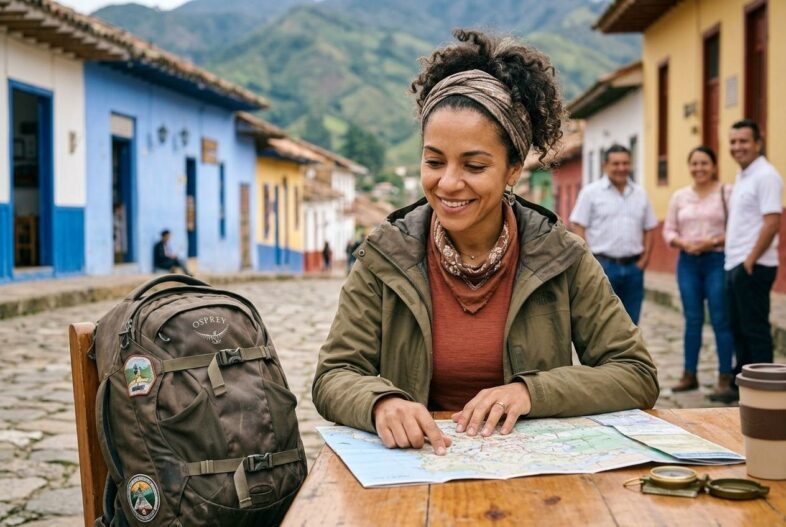
You know how a long trip can look simple on a map, then feel very different once you picture the lonely evenings, overnight buses and daily decisions? That is the real solo travel vs. group tours question for a five to six-month journey.
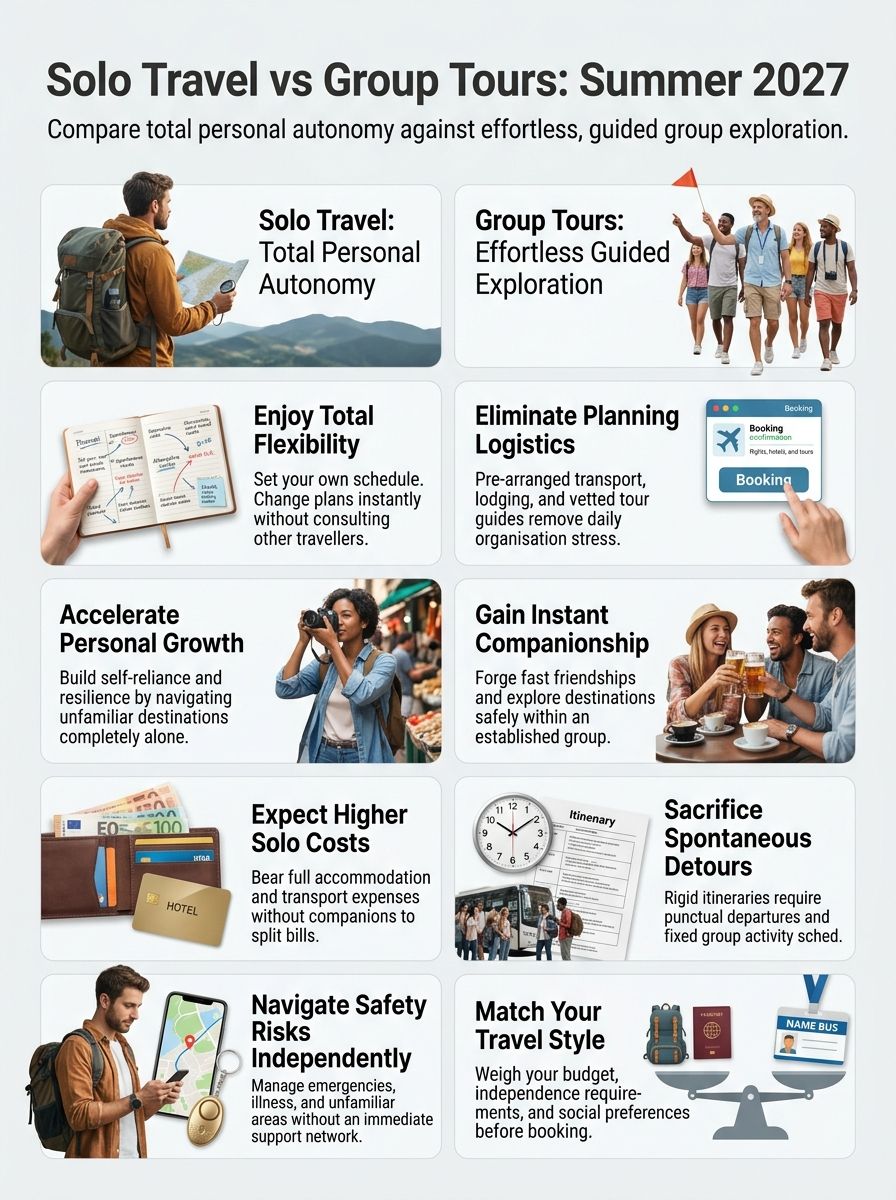
For Summer 2027, the best choice is rarely all one thing. Solo travel gives you control over your route and pace, while group travel removes pressure around travel logistics, safety concerns and meeting people.
This guide compares both styles, shows where each works best across Mexico, Central America and South America, and lays out a practical hybrid plan that keeps your independence without leaving every hard day to chance.
Key Takeaways
- Choose solo travel if you want full control of your route, budget and rest days, and you are willing to handle bookings, safety planning and occasional loneliness.
- Choose group tours if you want a built-in social circle and a tour guide who manages key travel logistics, especially for short, complex or remote legs.
- Group sizes vary more than people expect. G Adventures says its trips average 10 travellers and cap most groups at 15, while JoinMyTrip lists small groups of 3 to 12 people.
- Contiki suits travellers aged 18 to 35 and can use much larger groups, particularly in Europe and North America, so check the trip style before you book.
- For a five to six-month route, a hybrid plan often works best: travel independently for longer stretches, then add a seven to ten-day small group tour where company, transport or local knowledge matter most.
What Is Solo Travel?
Solo travel means travelling independently and making every major choice yourself. You choose your accommodation, meals, transport, route, activities and daily pace.
That freedom is the appeal. If you love a place in Oaxaca, Antigua, Cusco or Cartagena, you can stay longer. If a hostel feels noisy, a bus connection looks poor or your energy drops, you can change course without negotiating with travel companions.
It also means you manage the details. You need to compare transport options, check entry rules, book safe accommodation, keep backup payment methods and make decisions when plans change.
For a long trip, solo travel works best when you build a simple system: book your first few nights, keep a flexible route after that and leave room in your budget for changes.
What Are Group Tours?
Group tours bring travellers together on a planned itinerary, usually with a tour guide or trip leader handling much of the accommodation, transport and activity planning. You still travel as an individual, but you share the journey with a fixed group.
Group size makes a major difference. G Adventures states that most of its trips have up to 15 travellers, with an average of 10. JoinMyTrip focuses on groups of 3 to 12, while Contiki group sizes can be much larger depending on region and travel style.
That difference affects your experience. A group of six can adapt more easily to a late dinner, a scenic stop or a changed plan. A coach group of 30 or more usually moves faster and follows firmer timings.
As of September 2026, JoinMyTrip describes its TripLeaders as experienced travellers or local hosts who organise the itinerary and shared logistics. That can be useful when you want company without committing to a large bus tour.
Group travel can give you a social base and practical support, but the right group size matters just as much as the destination.
Advantages of Solo Travel
Solo travel gives you the widest choice of travel experiences. It works particularly well if you enjoy deciding each day for yourself and do not mind taking responsibility for the details.
Complete Freedom and Flexibility
A solo trip lets you change plans quickly. You can spend an extra week in Mexico City, leave a party hostel after one night, take a cooking class in Oaxaca or slow down in a quiet town without asking anyone else.
This flexibility matters on a five to six-month route because transport delays, weather and tiredness will affect your original plan. In Peru, for example, demonstrations can close roads and disrupt travel with little warning, so keeping a few unscheduled days can protect the rest of your itinerary.
- Book your arrival accommodation and first transfer before you land.
- Keep the next major transport booking flexible where possible.
- Plan one recovery day after long flights, overnight buses or high-altitude travel.
- Use a map app with offline areas saved before you lose signal.
Personalised Itinerary and Pace
Travelling independently lets you build travel itineraries around your travel preferences, not a group timetable. You can take fast travel days when you feel energised, then stay still when you want deeper cultural immersion.
That makes solo travel a strong fit for places with many worthwhile stops. You might spend two nights in Lima, a week around Cusco and the Sacred Valley, then take longer in one coastal town rather than racing across Peru.
For the Galapagos Islands, Bolivia, Africa or India, look at the effort behind every move, not only the distance. A short route on a map can still involve a flight, a long transfer, altitude adjustment or limited departure days.
| Travel preference | Solo approach | Best result |
|---|---|---|
| Fast-paced travel | Book transport legs close together, then protect rest days. | You cover more ground without turning every day into a transit day. |
| Slow travel | Stay at least five to seven nights in selected bases. | You spend less on transport and build stronger local routines. |
| Culture-led travel | Book local food, walking or language activities after arrival. | You can follow genuine interests rather than a preset schedule. |
Opportunity for Personal Growth
Travelling alone puts you in charge of small decisions all day. You learn to read a bus timetable, handle a delayed booking, ask for help and decide what matters enough to change your plan.
That is where personal growth comes from. It is less about dramatic transformation and more about gaining proof that you can solve ordinary travel challenges on your own.
Keep a short travel journal or voice note log. Write down what went well, what felt difficult and what you would do differently. Over months, that record helps you see progress instead of only recalling stressful moments.
Privacy and Independence
Solo travel gives you control over your social interactions. You can spend a full day with people from your hostel, then take the next day alone without worrying that you are leaving a group behind.
This can suit introverted travellers and anyone who needs quiet time after busy travel days. You choose your sleep schedule, meals, budget and how much conversation you want.
Private rooms cost more, but you do not need to book them every night. A useful middle ground is choosing dorm beds in social hostels for a few nights, then booking a private room after a long journey or before an early departure.
Disadvantages of Solo Travel
Independent travel can be deeply rewarding, but it asks more from you. Long trips add decision fatigue, higher individual costs and moments where you must deal with problems alone.
Potential Loneliness
Loneliness does not mean you chose the wrong trip style. It usually appears in predictable moments: after moving cities, during meals, when you are ill or after a busy day with nobody to talk to.
Hostels can help, but choose them carefully. A hostel with a shared kitchen, common area and scheduled walking tours usually creates more natural chances for meeting people than a cheap dorm with no communal space.
A practical rhythm is to stay in one social hostel for three or four nights, join one activity on the first full day and avoid forcing yourself to socialise every evening. That gives you repeated contact without turning your trip into a performance.
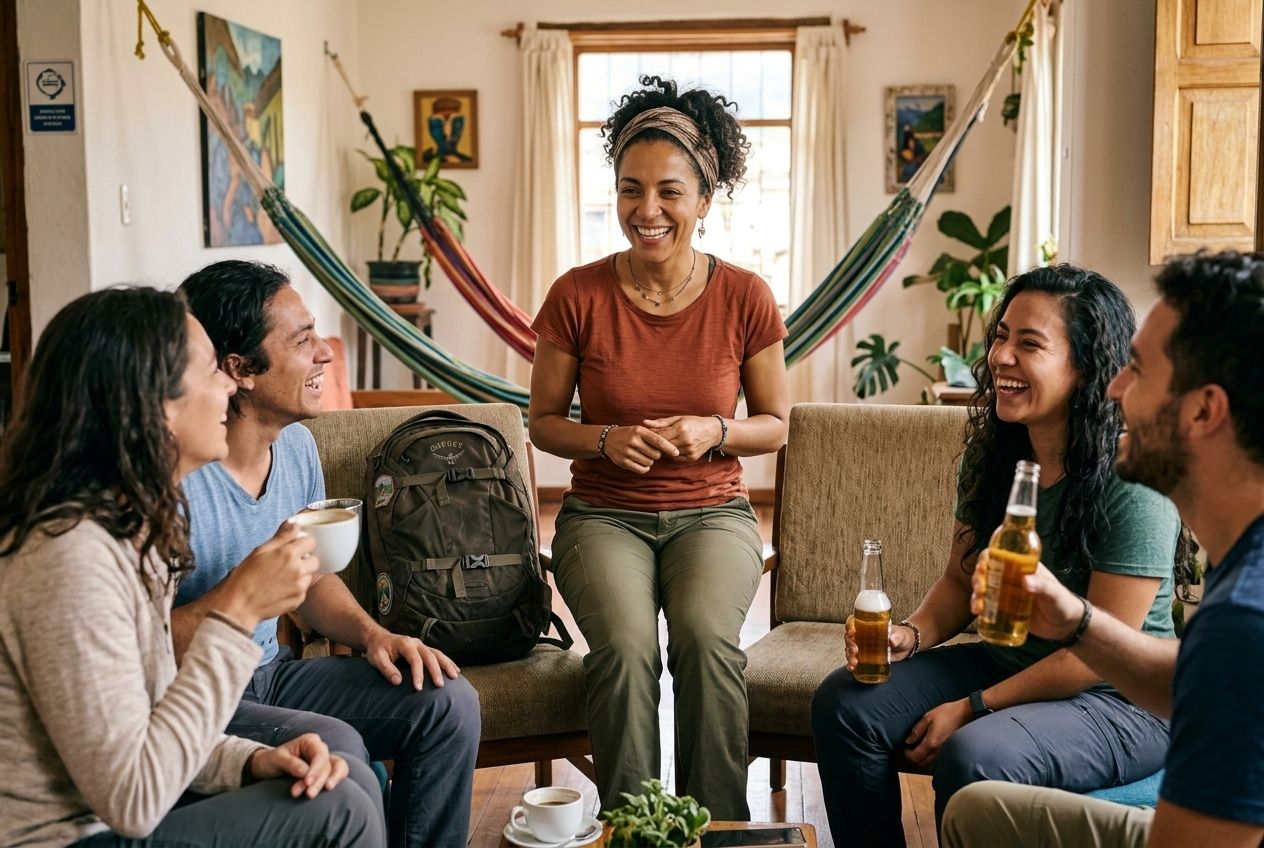
Loneliness is easier to manage when you plan for connection before you need it, rather than waiting for a difficult night to find company.
Higher Costs for Solo Accommodation
Solo travellers cannot split private rooms, taxis or many transfers. That is why accommodation often becomes the biggest difference between solo travel and group travel.
Group operators commonly pair solo travellers in twin or multi-share rooms. Contiki says same-sex twin or multi-share accommodation is standard on many trips, while G Adventures offers a paid private-room option called My Own Room on eligible trips.
Do not assume solo travel is always cheaper because you can use hostels. A dorm bed may save money, but frequent last-minute bookings, private transfers and short stays can quickly raise your daily cost.
- Set a separate accommodation budget for private-room recovery nights.
- Compare the full cost of a group tour with transport, rooms and activities included.
- Check whether airport transfers, entrance fees and optional activities sit outside the listed tour price.
- Keep a cash buffer for late arrivals, cancelled buses and safer transport choices.
Safety Concerns in Unfamiliar Locations
Solo travellers need a clearer safety routine because no travel companion is there to notice a wrong turn, check in after a long journey or help when you are unwell.
The current United States travel guidance makes route research essential. Mexico and Costa Rica are listed at Level 2, meaning travellers should exercise increased caution, while Colombia is listed at Level 3, meaning travellers should reconsider travel. Advisory levels and regional restrictions can change before Summer 2027, so check them again before booking each country.
In Mexico, United States guidance advises using dispatched vehicles from regulated taxi stands or app-based services rather than hailing taxis on the street. In Costa Rica, it warns against walking alone on poorly lit beaches or streets.
- Share your moving-day itinerary with one trusted person.
- Use an eSIM or local data plan so you can order transport and access maps.
- Carry one backup bank card separately from your wallet.
- Save accommodation addresses offline and screenshot key bookings.
- Buy travel insurance that includes medical care, evacuation and trip disruption.
Advantages of Group Tours
Group tours reduce the mental load of travel planning. They can be especially useful for a short section of a long trip, where you want to see a difficult destination without spending days researching every connection.
Pre-Planned Itineraries
A tour operator bundles decisions that can take solo travellers hours to make. You receive a route, joining point, transport plan, accommodation plan and a named contact for the trip.
G Adventures, Contiki and JoinMyTrip each package trips differently, so read the day-by-day itinerary rather than relying on the brand name alone. Check the number of one-night stays, included meals, free afternoons and optional activities.
For a short leg through Patagonia, the Amazon or Bolivia, planned travel logistics can save time and reduce the risk of missed connections. For a city-based trip where buses, hostels and tours are easy to arrange, you may prefer to keep control and travel independently.
Social Interaction and Travel Companionship
Group tours give you an immediate group of people to eat with, explore with and talk to during long transport days. That can make a major difference if loneliness is your main worry.
Contiki reports that 58% of its travellers join alone. That figure suggests you are unlikely to be the only solo traveller, though the social atmosphere will still depend on the route, age range and trip style.
Small groups also create repeated contact. You do not need to start from zero every time you enter a new hostel, which is one reason a seven to ten-day small group tour can work well in the middle of a longer solo trip.
- Choose an interest-led trip if you want easier conversation starters.
- Ask the operator about the usual age range and solo traveller mix.
- Read the room-sharing policy before you pay a deposit.
- Join the pre-departure group chat, but do not judge group dynamics before the trip begins.
Safety in Numbers
Travelling with others can make unfamiliar transport hubs, evening walks and border crossings feel less exposed. A group also gives you more people who can help if you lose a bag, feel ill or need local advice quickly.
A tour guide does not remove all risk. You still need insurance, emergency contacts, sound judgement and awareness of your surroundings.
The practical benefit is support. A good leader knows the planned route, has local contacts and can help the group respond if weather, protests or transport changes disrupt the itinerary.
Access to Local Experts and Guides
A strong tour guide can turn a rushed stop into a better cultural experience. They can explain local customs, organise practical details and point you towards restaurants, markets or neighbourhoods you may not find in a quick online search.
Guides are most valuable where language, transport or safety factors make independent travel harder. They are less valuable if the itinerary only gives you a short photo stop and no time to explore beyond the group.
Before booking, ask whether the trip uses one tour guide throughout, local guides for selected activities or both. That answer tells you how much context and practical support you are likely to receive.
Disadvantages of Group Tours
Group travel solves some common travel challenges, but it replaces them with shared schedules, group dynamics and less freedom. The key is knowing which compromises you can accept.
Limited Flexibility in Plans
Most group tours have set departure dates, meeting times and transport bookings. You cannot stay longer at a beach, skip a city or take a spontaneous side trip if the group needs to move on.
Contiki makes clear that its group size varies by region and season, with groups in Europe, North America and New Zealand ranging from 24 to 53 travellers. Larger groups usually need firmer timing, so they suit people who value structure more than flexibility.
Read the itinerary for early starts and one-night stays. If you see several in a row, expect a faster pace than the headline destination count may suggest.
Potential for Personality Clashes
Group dynamics can become tiring when people have different budgets, drinking habits, energy levels or ideas about punctuality. Sharing rooms can also feel difficult if you need privacy or sleep lightly.
You cannot choose every travel companion, but you can reduce the risk. Pick a group with an age range and activity level that suits you, and ask about room arrangements before you commit.
In traveller discussions, a common warning is that the group size matters more than the operator label. A group of 10 gives you fewer people to avoid, while a group of 40 gives you a better chance of finding your people but less influence over the plan.
Set Schedules and Activities
A fixed itinerary can make travel efficient, but efficiency is not always depth. You may see more places in fewer days while having less time to sit in a neighbourhood, return to a favourite café or follow an unexpected local recommendation.
Look for tours that build in genuine free time, not only time allocated for optional paid activities. Contiki states that many trips include free time, but the amount differs by itinerary, so confirm the daily schedule before you book.
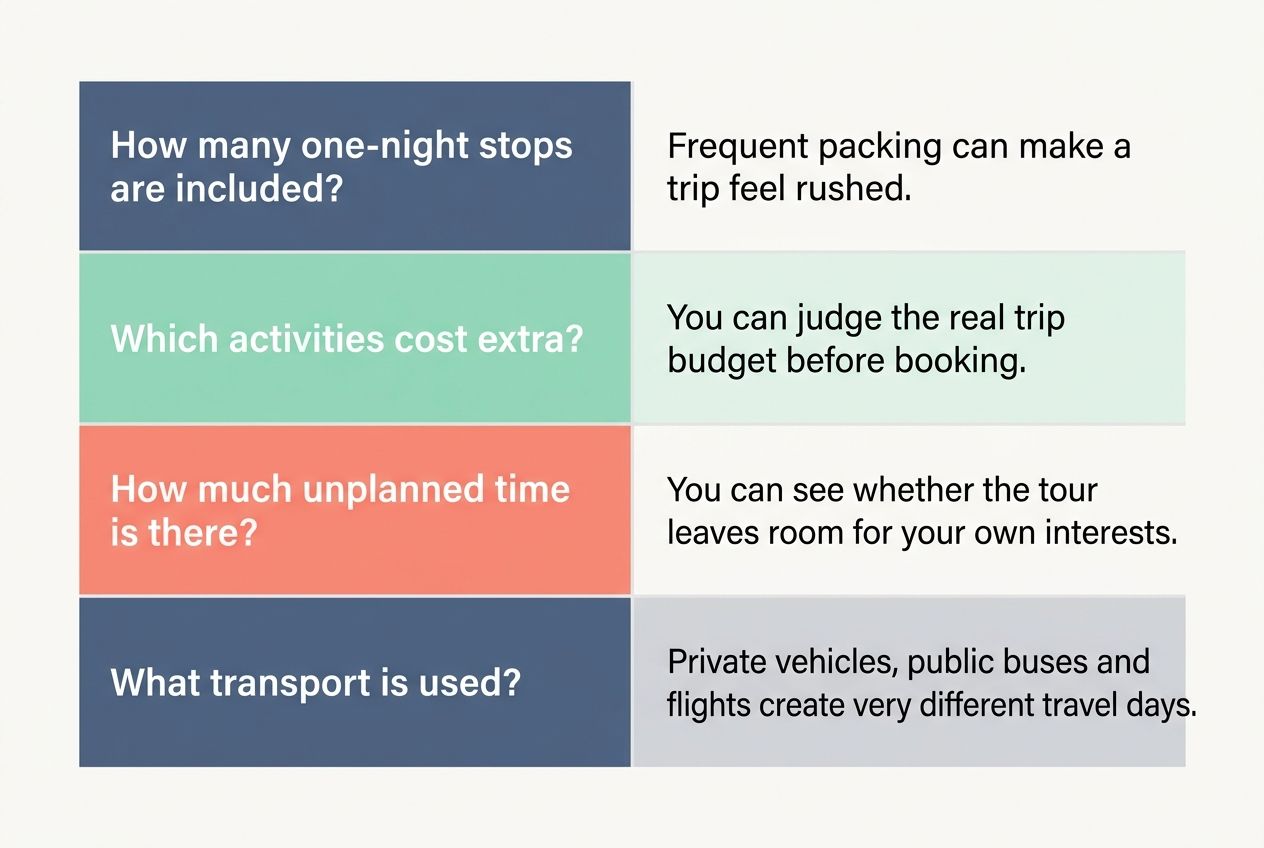
| Question to ask | Why it matters |
|---|---|
| How many one-night stops are included? | Frequent packing can make a trip feel rushed. |
| Which activities cost extra? | You can judge the real trip budget before booking. |
| How much unplanned time is there? | You can see whether the tour leaves room for your own interests. |
| What transport is used? | Private vehicles, public buses and flights create very different travel days. |
Key Factors to Consider When Choosing
The right travel choice depends less on whether you are brave or sociable and more on how you respond to uncertainty. Think about your money, energy, safety needs and comfort with meeting people before you choose.
Budget and Travel Style
Solo travel gives you more ways to cut costs, such as cooking, using public transport and choosing hostels. It also exposes you to solo supplements, last-minute booking costs and private transfers that a group may spread across several people.
Group tours cost more upfront in many cases, but the price can be easier to manage because key transport and accommodation are arranged. Compare total costs, not only the advertised price.
For a five to six-month route, set three budgets: your daily solo budget, your emergency fund and your group-tour fund. That structure lets you use a small group tour where it adds real value rather than booking one because you feel pressured after a lonely week.
Desired Level of Independence
Ask yourself what you want control over. If you care most about your wake-up time, accommodation standard and route changes, solo travel will suit you better.
If you would rather hand over transport planning, room bookings and activity coordination for part of the trip, a small group tour can be a smart break from decision-making. You can still keep your independent travel before and after it.
A useful test is to plan a seven-day solo route on paper. If researching buses, border crossings and accommodation feels exciting, go solo. If it feels like work before you have even left home, use a group tour for that section.
Comfort With Meeting New People
Hostels, walking tours and day trips make meeting people easier, but solo travellers still need to start conversations and show up more than once. Group tours make those first steps easier because the same people share the itinerary.
If you are unsure, do not frame the decision as solo travel or group travel forever. Start with a short small group tour, then take a longer solo leg once you feel more settled.
JoinMyTrip can suit this middle ground because its trips generally run with 3 to 12 people. G Adventures may suit you if you prefer an established small-group operator with an average group size of 10, while Contiki can appeal if you are 18 to 35 and want a more social, larger-group atmosphere.
A Hybrid Plan for Mexico, Central America and South America
For most people planning five to six months, I would not choose only solo travel or only group tours. I would build a route that uses each style where it does its best work.
Travel solo in places where you want flexibility and where accommodation, transport and social hostels make independent travel straightforward. Add small group tours for remote routes, multi-day treks, complicated border areas or weeks when you want reliable travel companionship.
Where Solo Travel Makes Sense
- Mexico City and Oaxaca: Stay longer, follow food and culture interests, and adjust your pace without losing much time.
- Antigua and Lake Atitlán: Use one hostel base, join day activities and meet people without moving every day.
- Costa Rica: Keep plans flexible, but book late arrivals and remote transfers carefully because safety and transport choices matter.
- Cusco and the Sacred Valley: Give yourself acclimatisation time before demanding activities at altitude.
Where a Small Group Tour Can Add Value
- Patagonia: Weather, long distances and limited transport can make shared planning useful.
- Amazon regions: A guide, arranged transfers and a clear safety plan can simplify a complex area.
- Bolivia: A small group can help with multi-day routes where shared transport and local knowledge improve travel efficiency.
- A multi-day trek: A tour guide, equipment checks and a fixed support team can reduce logistical pressure.
Sample Five to Six-Month Rhythm
| Travel phase | Style | Purpose |
|---|---|---|
| First two to three weeks | Small group tour or social hostel base | Ease into the trip, meet people and learn your travel rhythm. |
| Next four to six weeks | Solo travel | Build confidence and stay longer in places you enjoy. |
| One demanding destination | Seven to ten-day group tour | Reduce travel logistics and add local support. |
| Longer final leg | Mostly solo travel | Use what you have learned to travel at your preferred pace. |
Conclusion
Solo travel gives you freedom, flexible travel itineraries and room for personal growth. Group tours give you travel companionship, shared logistics and a tour guide when the route feels complex.
For Summer 2027, a hybrid plan is often the strongest option. Travel independently through the places where you want time and choice, then book a small group tour through JoinMyTrip, G Adventures or another suitable operator for a short stretch where company and support will improve the experience.
That balance lets you keep the best part of solo travel, control over your journey, without carrying every travel challenge alone.
FAQs
1. Should I choose solo travel or group tours for Summer 2027?
Solo travel suits you if you want freedom and a flexible itinerary, and group tours suit you if you want set plans, shared costs and instant company.
2. Are group tours cheaper than solo travel?
Often, yes, group tours cut costs because operators book transport and lodging at bulk rates. You can still save on solo travel with careful planning and budget lodging.
3. Is solo travel safe for Summer 2027?
Safety hinges on good planning and local rules; research destinations, check travel advice and share your plan with someone you trust. Data show travellers who prepare reduce risks, and choosing reputable companies for parts of a trip helps too.
4. How do I pick between solo travel and group tours?
List your priorities: freedom, cost, social life, safety and pace, then match them to the option that meets most needs, and book a flexible refund policy for peace of mind.








 Verified by