
Methane migration is the transfer of methane gas from a source to the surface or adjacent structures via subterranean pathways such as soil, rock fissures, groundwater, or marine sediments. It presents serious concerns for explosions, public health, climate change, and environmental contamination.
Key Points Worth Noting:
- Subsurface methane can migrate horizontally through soils and vertically into buildings, creating explosion, asphyxiation, and toxic hazards far from the original source.
- Landfill sites are the most common source of problematic methane migration.
- The Lower Explosive Limit (LEL) for methane is 5% by volume in air — a threshold that regulatory frameworks like RCRA Subtitle D use as a critical trigger point for action.
- Methane-only monitoring misses the full picture — VOCs, H₂S, and CO₂ frequently co-migrate and can present independent health and safety risks.
- Continuous borehole monitoring systems with telemetry capabilities are rapidly replacing periodic manual sampling as the industry standard for high-risk sites.
- There's a monitoring method limitation most site assessors overlook — near-surface gas data alone cannot confirm whether gas is actually migrating off-site to nearby structures.
Subsurface methane migration is one of the most underestimated hazards in site assessment, and the consequences of getting it wrong range from structural damage to fatal explosions.
Unmanaged subsurface gas migration can be a serious danger to both the environment and human health, often without any warning until a building is filled with gas or a confined space becomes deadly. Energy professionals, site investigators, and environmental engineers working near landfills, abandoned coal mines, or shale gas infrastructure need a clear, technical understanding of how methane moves underground, how to detect it reliably, and what the regulations actually require.
Specialist companies in gas detection instrumentation are available that provide detailed guidance on subsurface and ground gas monitoring for professionals navigating exactly these challenges.
The Origins of Subsurface Methane
Methane doesn't just randomly show up below a site. It comes from specific sources, and understanding the source significantly alters the risk assessment process.
The Most Common Man-Made Source: Landfill Gas
The most common man-made source of subsurface methane is municipal solid waste (MSW) landfills. As organic waste decomposes without oxygen under the surface of the landfill, it produces landfill gas. This gas is primarily a mixture of methane (CH₄) and carbon dioxide (CO₂). It also contains trace amounts of non-methane organic compounds (NMOCs), hydrogen sulfide (H₂S), and volatile organic compounds (VOCs). The gas doesn't stay in one place. It moves through the soil in all directions. This movement is driven by differences in pressure, differences in concentration, and the permeability of the materials around it.
According to U.S. federal law (RCRA Subtitle D) and EU Directives, it is mandatory for MSW landfills to measure methane levels around the landfill's perimeter. The regulatory limit is straightforward: if the methane levels at the property boundary monitoring stations go beyond the Lower Explosive Limit (LEL), immediate action is required by the operator. Outside the boundary, the same gas can move beneath roads, drainage systems, and building foundations — frequently with no surface sign that migration is happening. For more insights on managing landfill gas, you can read about landfill gas extraction well design.
Important point: Chemical concentrations in the vapor space of soils are measured by soil gas monitoring programs using probes or wells installed at depth. U.S. landfill regulations use methane as the principal indicator for potentially dangerous landfill-gas migration at the facility boundary. However, methane is only one component of landfill gas. Other constituents—including VOCs and hazardous air pollutants—can migrate with the gas but are not necessarily characterized by routine methane monitoring.
Abandoned Coal Mines and Coal Bed Methane
Abandoned coal workings represent another significant and often poorly mapped source of subsurface methane. Methane that is adsorbed naturally in coal seams, known as coal bed methane (CBM), can desorb and migrate through fractured rock and overlying soils when mining activity disrupts the in-situ pressure equilibrium. Old mine entries, shafts, and goaf areas act as preferential pathways for gas movement, sometimes over considerable distances from the original workings.
Shale Gas Production and Pipeline Leaks
Shale gas extraction introduces methane migration risk through wellbore integrity failures, surface casing leaks, and hydraulic fracturing operations that intersect natural fault networks. Pipeline infrastructure adds another layer of risk — even small, chronic leaks from ageing distribution lines can saturate surrounding soils with methane over time, creating explosive concentrations in nearby utility corridors or building sub-floors.
In contrast to landfill gas, thermogenic methane from shale formations has a unique isotopic signature. Carbon isotope ratio analysis (δ¹³C) is a technique used to distinguish between thermogenic and biogenic methane sources during forensic investigations. This is a crucial distinction when it comes to issues of responsibility and regulatory reporting.
Soil and Rock's Natural Geochemical Sources
Methane found beneath the surface isn't always the result of human activity. Natural geochemical processes, such as microbial methanogenesis in waterlogged or peat-rich soils, can produce high concentrations of methane without any nearby industrial activity. Sites that sit atop organic-rich geological layers, former wetlands, or shallow coal measures may show high methane levels that are unrelated to current or past industrial use. This distinction is important because it influences both the risk model and the response to remediation. For more information on methane sources and solutions, you can explore landfills and methane gas solutions.
An example of natural methane migration occurred in the UK. 16 people were killed in the Abbeystead disaster on May 23, 1984, when a methane gas explosion destroyed the valve house of a waterworks in Abbeystead, Lancashire, England.
The Journey of Methane “Through the Earth” (Subsurface)
For those conducting site risk assessments, it is vital to understand the mechanics of migration. This knowledge will directly influence where you position monitoring points and how you interpret the data.
Methane Movement in Soil Gas
Methane produced at a source point travels sideways through permeable soil layers due to pressure gradients. Coarse-grained soils, gravel beds, and utility backfill materials are especially good conduits, enabling gas to move considerable distances from the source. At many landfill sites, sideways movement has been confirmed at distances beyond the property boundary, reaching basements and subsurface voids of nearby residential and commercial buildings.
An example of a disastrous landfill gas occurrence occurred in Loscoe, Derbyshire, UK, on March 24, 1986. A private cottage was destroyed when migrating methane from a recently capped landfilled quarry migrated through thin coal seams underground into a bungalow after a sudden, severe reduction in atmospheric pressure.
Soil gas samples are typically collected from either permanent probes or temporary drive-point samplers. These samples capture concentrations at a specific depth and location. However, because concentrations fluctuate as gas moves through the subsurface, a single sampling event usually doesn’t provide a comprehensive picture of the extent of migration. This is why long-term monitoring programs using fixed probe networks are the industry standard for high-risk sites.
Methane Rising into Homes and Enclosed Spaces
Methane rising from the ground into buildings turns a subsurface gas issue into a potentially life-threatening situation. Methane can rise through the soil and enter buildings through cracks in the foundation, service penetrations, sump pits, and poorly sealed utility entries. Once inside an enclosed space, the concentration of methane can increase rapidly, especially in basements, crawl spaces, and sub-floor voids where there is limited ventilation. The gas builds up without any odour to warn of its presence, until the concentration reaches a point where it can explode.
Ground gases — including landfill gas and naturally occurring soil gases — can migrate into buildings or confined spaces and accumulate to asphyxiating, toxic, and explosive concentrations. This isn't a theoretical scenario. It is a documented, recurring hazard at sites adjacent to active and closed landfills, and at brownfield developments built over contaminated ground.
Changes in Gas Concentrations During Migration
Gas concentrations do not remain the same. They can vary due to changes in barometric pressure, soil moisture content, temperature gradients, and seasonal changes. Changes in barometric pressure are especially important — when atmospheric pressure decreases, gas that was previously trapped in the soil matrix can be released quickly, leading to sudden spikes in concentration that may not be detected by a periodic manual sampling program. This dynamic behaviour is one of the main reasons why continuous monitoring is preferred over grab sampling at high-risk sites.
Interpreting the Explosion Risk: What the Statistics Really Indicate
While methane's combustibility range is limited, it is relentless, and every expert dealing with subsurface gas data must comprehend precisely what the statistics signify in real-world terms.
Understanding the Lower Explosive Limit (LEL) and Its Importance
Methane's Lower Explosive Limit (LEL) is 5% by volume in air. This means that methane-air mixtures can ignite when concentrations reach or exceed this limit. The Upper Explosive Limit (UEL) for methane is 15% by volume. Therefore, any ignition source, such as a light switch, a static discharge, or a power tool, can cause an explosion within this 5–15% range. Mixtures with less than 5% methane are too lean to ignite, while those with more than 15% methane are too rich. However, the area between these limits poses a severe and immediate danger.
RCRA Subtitle D uses methane's lower explosive limit (LEL) as the basis for its explosive-gas controls. Under 40 CFR §258.23, methane generated by a municipal solid waste landfill must not exceed 25% of the LEL — approximately 1.25% methane by volume — within facility structures, or the LEL itself — approximately 5% methane by volume — at the facility property boundary. If these limits are exceeded, the operator must immediately take steps to protect human health, make the required notification and record within seven days, and implement a remediation plan within 60 days. The lower 1.25% threshold for structures provides a safety margin well before methane reaches an explosive concentration, whereas the property-boundary limit corresponds to methane's LEL.
Dangerous Levels of Methane Concentration
Methane poses a threat long before it hits the LEL. The mix is nearing the explosive range at concentrations of 1% to 5% by volume. In enclosed areas with limited air exchange, levels can rise from trace amounts to the explosive range in just a few hours.
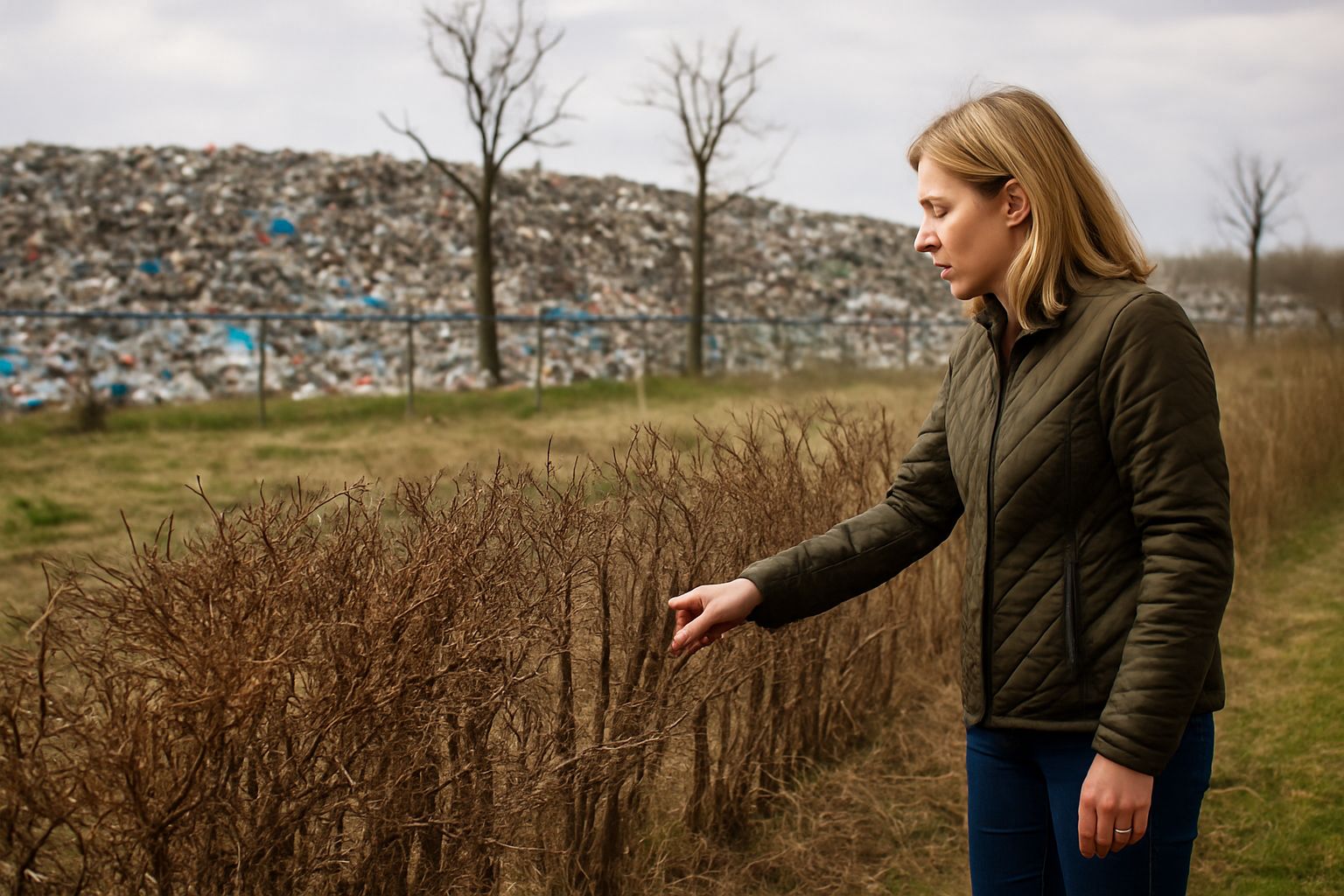
A critical point that some site assessors may overlook is that near-surface methane readings taken 4 inches above the ground surface on a landfill do not accurately represent what may be building up inside a nearby basement or utility vault. There is additional dilution as gas moves from the source to the receptor, but this dilution is not always enough to prevent dangerous accumulations in enclosed spaces.
Other Risks Besides Explosion
Methane itself is not toxic, but it can displace oxygen. When methane levels are high in a confined space, oxygen levels drop correspondingly. When oxygen levels drop below 19.5%, physiological effects begin, such as impaired judgment, increased breathing rate, and fatigue. When oxygen levels drop below 16%, the situation becomes life-threatening. A worker entering a confined space with 30% methane by volume is breathing air with an oxygen concentration that cannot sustain consciousness for long. For more insights, you can explore UK landfill gas energy insights.
Most regulatory discussions focus on the risk of explosion, but the monitoring of methane alone completely overlooks the independent dangers posed by co-migrating gases. Hydrogen sulfide (H₂S) is often found in landfill gas and is acutely toxic at concentrations above 100 ppm and immediately life-threatening at 300 ppm. Landfill gas also contains VOCs, including benzene, a known human carcinogen, as well as toluene, ethylbenzene, and xylene compounds. Carbon dioxide often migrates with methane and can cause unconsciousness at concentrations above 5% and death above 10%. For more detailed information, you can refer to the ATSDR's landfill gas guide.
- H₂S: At 100 ppm, it's immediately dangerous to life and health (IDLH). It can be detected by smell at low concentrations, but at higher levels, it causes olfactory fatigue, removing the only natural warning signal.
- CO₂: It's IDLH at 40,000 ppm (4% by volume). It is often present in landfill gas at concentrations of 30–50% of the total gas mixture.
- Benzene (VOC): The OSHA permissible exposure limit is 1 ppm as an 8-hour TWA. The International Agency for Research on Cancer (IARC) classifies it as a Group 1 human carcinogen.
- Carbon Monoxide (CO): It can be present in landfill gas from partial combustion reactions. It's IDLH at 1,200 ppm.
Any thorough subsurface gas risk assessment must consider all of these co-contaminants, not just methane. If decision-makers rely solely on methane data, they get an incomplete and potentially hazardous picture of the actual site risk.
How to Choose the Right Soil Gas Detection Method
There are many ways to detect soil gas, but the right method for you will depend on the specific conditions of your site, the regulations you need to follow, and the specific questions you're trying to answer. For example, understanding the landfill gas risks is crucial if your site is near a landfill. There's no one-size-fits-all solution.
What Near-Surface Gas Sampling Can and Can't Tell You
Near-surface gas monitoring involves taking measurements at a point no more than 4 inches (about 10 cm) above the ground. It's typically used on the surface of landfills to find point sources of high gas levels, such as cracks in cover systems, failed membrane sections, or areas where a lot of gas is being produced. This data can help you decide where to install permanent probes and figure out where you might need to repair the cover. But what it can't reliably tell you is whether gas is moving off the site. That's because it measures emissions from the surface, not how gas moves under the surface. The amount of dilution in the atmosphere and the direction of the wind can have a big effect on the measurements at this height. And methane concentrations in the outside air at normal levels don't pose a risk of being breathed in or exploding. That's why it's so important not to confuse measurements from the surface with the risk of gas moving under the surface.
Subsurface Methane Monitoring Devices
Deep soil gas monitoring — typically below 10 feet (3 meters) — uses permanently installed probes or wells to capture gas concentrations within the subsurface migration zone. Probes are constructed with screened intervals at specific depths, allowing investigators to characterise gas concentration profiles vertically through the soil column. Data from these installations are far more representative of actual migration behaviour than near-surface measurements, and form the foundation of any defensible long-term monitoring program. At MSW landfills, borehole-based perimeter monitoring stations are the standard approach for RCRA Subtitle D compliance.
Monitoring VOC, H2S, and CO Together with Methane
When you want to monitor more than just methane, you'll need tools that can detect several target compounds at the same time or one after the other. Photoionisation detectors (PIDs) are the go-to tool for detecting VOC in soil gas investigations because they can measure total VOC concentrations at less than one part per million. Electrochemical sensors are commonly used to detect H₂S and CO, while infrared (IR) sensors can accurately measure methane and CO₂ at all concentrations, from trace amounts to pure gas.
Continuous Ground Gas Monitoring
While periodic grab sampling provides a snapshot, continuous monitoring provides the full story. For sites where gas behavior is dynamic and the consequences of a missed spike are severe, the full story is what matters.
There has been a move towards continuous ground gas monitoring due to an increased understanding that fluctuations in barometric pressure, changes in seasonal soil moisture, and occasional gas generation events can lead to spikes in concentration that a quarterly or monthly sampling program will never detect. Even if a site reads below LEL thresholds on every scheduled sampling visit, it may still present explosive concentrations in nearby buildings during low-pressure weather events. Without continuous data, this risk is not visible.
Battery-Operated, Unmanned Borehole Monitoring Systems
Modern continuous ground gas monitoring systems are designed to be installed directly into monitoring boreholes and can operate independently on battery power for extended periods without the need for site attendance. These systems use datalogging electronics in combination with electrochemical and IR sensor arrays to record gas concentrations, temperature, barometric pressure, and — in more advanced configurations — groundwater level data at programmed intervals as frequent as every few minutes. The ability to log gas concentration data simultaneously with barometric pressure is particularly useful, as it allows investigators to directly correlate concentration spikes with pressure drop events and develop a mechanistic understanding of migration behaviour at the site.
Remote Data Transmission vs. On-Site Data Collection
Systems that have telemetry modules — either GSM/GPRS or satellite-based — send data in real time to cloud platforms or monitoring dashboards. This allows for remote alerting when concentrations are nearing or exceeding threshold values. This feature turns ground gas monitoring from a periodic activity that is reactive into a live tool for risk management. On-site data collection systems, where a technician has to visit the site to get data from the logger, are cheaper but add latency into the process of risk management. This is a limitation that is becoming harder and harder to justify on high-risk sites that are near occupied structures.
Long-Term Data Analysis and Multi-Gas Recording
Patterns that grab sampling can't reveal are made visible by long-term continuous datasets. When data is recorded continuously over months and years, the cumulative effect of barometric pressure cycles on subsurface gas behaviour, the relationship between soil moisture and gas migration efficiency, and seasonal trends in gas generation all become visible. These datasets are the evidentiary backbone of risk assessments submitted to regulators, and planning authorities on sensitive developments increasingly expect them.
Multi-gas logging systems that can record methane, CO₂, O₂, H₂S, and VOC concentrations at the same time as environmental parameters give the most comprehensive data set for risk characterisation. When data shows that H₂S and methane are consistently co-migrating, for example, it raises a combined explosion and toxicity risk profile that requires a different remedial response than methane alone. This is true both in terms of engineering controls and personal protective equipment requirements for workers entering the affected zone.
Legal Standards for Methane Monitoring
Legal standards provide the baseline — but on complicated sites, achieving the baseline is often not enough to accurately assess the actual risk. For instance, understanding the landfill gas production rate can be crucial in evaluating the potential hazards effectively.
Methane Monitoring Requirements Under RCRA Subtitle D
In the United States, operators of MSW landfills are required by Subtitle D of the Resource Conservation and Recovery Act (RCRA) to implement a methane monitoring program that covers the landfill perimeter and on-site structures. Monitoring must be conducted at least quarterly under standard conditions, with increased frequency required when exceedances are detected. The monitoring network must be designed to detect methane migration through all subsurface pathways. This means that probe placement must account for site-specific soil stratigraphy, preferential migration corridors, and the locations of nearby structures or utilities that could act as gas conduits. For more information on methane gas solutions, you can explore landfills and methane gas solutions.
What Occurs If LEL Limits Are Surpassed
If methane concentrations at the property boundary surpass 1.25% by volume (25% of the LEL), or concentrations within facility structures surpass 5% by volume (100% LEL), RCRA Subtitle D mandates that the landfill operator inform the appropriate state agency within seven days of detecting the exceedance. A remediation plan must be executed within 60 days. Remediation options encompass installation or expansion of active gas extraction systems, installation of passive venting systems, enhanced cover system repair, or combinations of these strategies depending on the migration pathway and source characteristics.
RCRA notification and remediation requirements are the bare minimum, not the maximum safety measures. In situations where migration has already reached structures off the site, the 60-day window for remediation may not be enough to protect the people inside — especially if the exceedance was found during a quarterly visit that happened weeks after the concentration became dangerous. This is the exact scenario that continuous monitoring with real-time alerting is meant to prevent.
Monitoring Responsibilities After a Landfill Has Been Closed
Just because a landfill has been closed does not mean that the risk of methane migration has been eliminated. In fact, it often changes. As active gas extraction systems are shut down and the rate of landfill gas generation decreases over the years, the pressure dynamics that caused migration during active operation change. Some closed landfills continue to produce measurable amounts of methane for 30 to 50 years after closure as the remaining organic waste slowly decomposes.
According to RCRA Subtitle D, methane monitoring must continue for at least 30 years after closure, although regulatory agencies can extend this period if gas generation data shows that the risk has not decreased enough. Operators of closed facilities who believe that monitoring responsibilities end when the site is closed are exposing themselves to serious regulatory and liability risks.
Understanding Explosion Risk: A Hands-On Guide
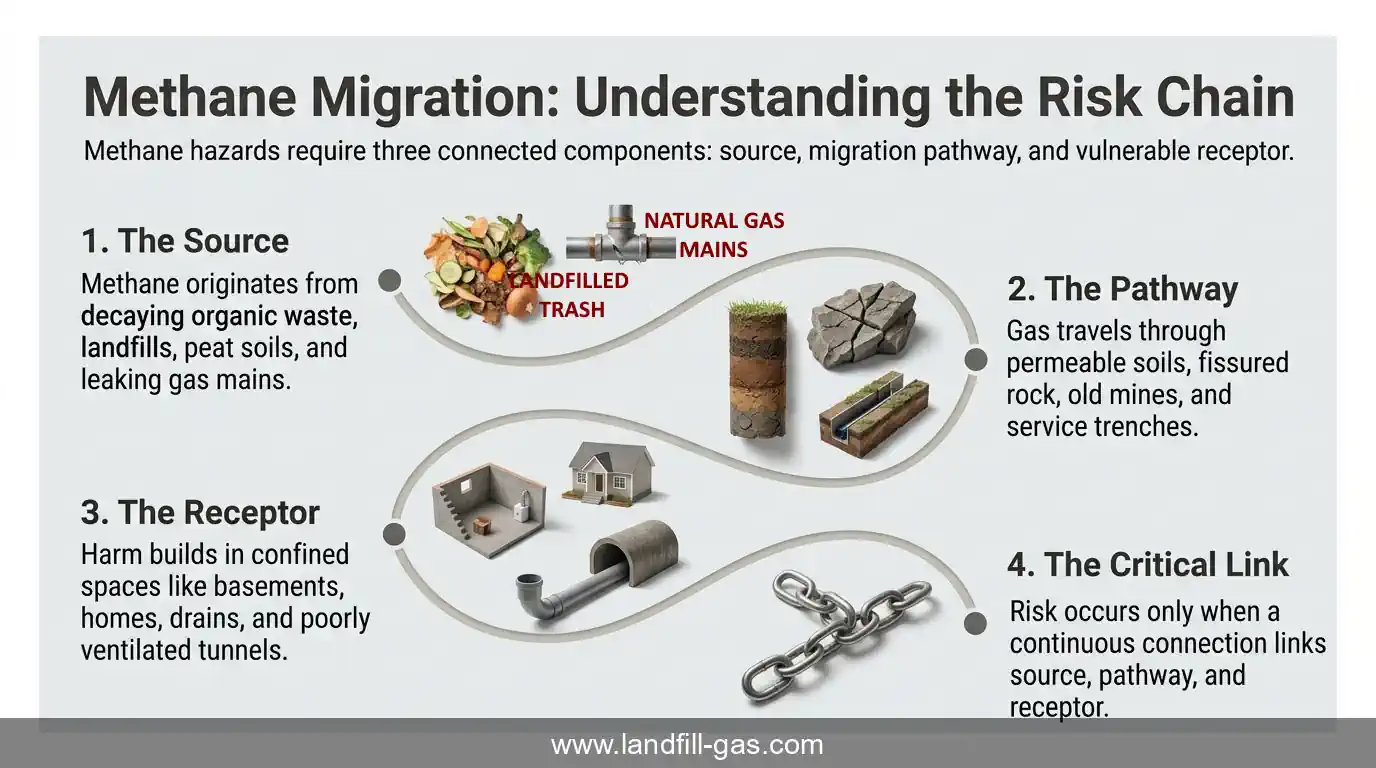
Building a strong explosion risk assessment for a location with known or suspected subsurface methane begins with a well-defined conceptual site model. This model should outline the source, the migration pathways, and the potential receptors before any probes are installed. Without this structure, any monitoring data collected is meaningless. However, with it, every piece of data collected contributes to an understanding of whether explosive concentrations could realistically build up in occupied spaces, utility corridors, or confined work areas on or near the location. For more information on designing effective systems, you can explore landfill gas extraction well design.
The evaluation must take into account fluctuating conditions, rather than just a single worst-case scenario. The behaviour of gas changes with barometric pressure, season, and soil conditions. A risk assessment that is based on a single round of grab samples taken during stable high-pressure conditions will consistently underestimate peak concentrations and may miss the exact conditions under which explosive accumulations are most likely to form.
- Identify the origin: Whether it’s a landfill, coal mine, pipeline leak, or natural geochemical source, each has different gas compositions, generation rates, and migration behaviours
- Plot the routes: Soil stratigraphy, permeability contrasts, utility corridors, drainage systems, and geological discontinuities all influence where gas travels
- Determine the receptors: Occupied buildings, basements, crawl spaces, utility vaults, confined work areas, and any enclosed space where gas could accumulate
- Set baseline concentrations: Background methane levels must be characterised before anomalous readings can be interpreted meaningfully
- Use dynamic monitoring: Continuous logging that captures barometric pressure cycles and seasonal variation provides the most defensible dataset for risk conclusions
The result of this process should be a quantified risk characterisation — not just a statement that methane is present, but a technically supported conclusion about whether concentrations at receptor locations can reach or exceed LEL thresholds under credible site conditions, and what engineering controls are necessary to reduce that risk to an acceptable level.
Assessing the Dangers of Off-Site Fires and Explosions
An off-site explosion risk assessment necessitates monitoring between the source and the nearest occupied structures, not just at the property boundary. Property boundary data informs you if the regulatory threshold has been exceeded at the fence line, but it does not inform you of the concentrations present in the basement of a house 50 meters beyond that boundary. If residential or commercial receptors are within a reasonable migration distance of a methane source, soil gas probes should be installed at intermediate locations and, if access is permitted, within the structures themselves. Sub-floor void monitoring, basement air sampling, and utility corridor gas surveys are all important parts of a comprehensive off-site hazard assessment.
Detecting Migration Pathways with Soil Gas Data
- Concentration gradients: The closer the source, the higher the concentration. As you move away from the source, the concentration decreases. This is a common pattern when transport through homogeneous soil is dominated by diffusion.
- Anomalous off-gradient readings: When the concentration is elevated in areas that do not follow the diffusion gradient, it often suggests that migration is preferential along a utility corridor, gravel layer, or geological feature.
- Depth profiles: If you use multi-level probes to create vertical concentration profiles, you can determine whether gas is primarily migrating through shallow or deep soil layers.
- Temporal patterns: If you notice concentration increases that correlate with drops in barometric pressure, it's a good sign that pressure-driven migration is a dominant transport mechanism.
When designing soil gas probe networks, you should base them on the conceptual site model rather than arbitrarily placing them at intervals. While a grid-based approach works well on simple sites with homogeneous soils, on complex sites with variable stratigraphy, you'll get much more useful data with fewer probes if you take a targeted approach based on known or suspected preferential pathways.
Once we have identified a migration pathway leading to a structure through soil gas data, the first thing we need to check is whether there are explosive or toxic concentrations in that structure. We should immediately monitor the sub-floor and basement, and review the results against both LEL thresholds and health-based screening levels specific to the compound for any co-contaminants present in the gas mixture.
Soil gas monitoring wells can be used to detect off-site subsurface pathways and identify potentially at-risk buildings when they are placed in the right locations and interpreted in conjunction with site geological data and infrastructure maps. This pathway-receptor analysis provides the necessary information for decision-makers to determine if gas collection and treatment systems are needed to ensure public safety, and where they should be installed for maximum effectiveness.
Shortcomings of Methane-Only Monitoring for Risk Assessment
While methane data collected under regulatory minimum requirements is useful for evaluating explosion risk and for getting a qualitative sense of whether landfill gases are migrating off-site, it falls short in characterising the full toxicological risk profile of the gas migrating through the subsurface. When only methane is measured, the presence of H₂S, benzene, vinyl chloride, and other hazardous compounds in the migrating gas plume goes entirely undetected — creating a false sense of confidence in sites that may carry significant inhalation health risks alongside the explosion hazard.
When gas migration has been proven to reach off-site receptors at any site, a full multi-compound soil gas characterisation is required. This includes VOCs analysed by EPA Method TO-15 or an equivalent method, H₂S by a direct-reading electrochemical sensor or Dräger tube, CO₂ by an IR sensor, and oxygen by an electrochemical cell. This expanded dataset allows for a comprehensive explosion risk assessment and a health risk evaluation that can stand up to regulatory and legal scrutiny.
Every Development Site Should Prioritise Methane Monitoring
Places where subsurface methane migration has caused significant damage are seldom the ones where everyone was aware of the issue. Instead, they are often the sites where the risk was deemed low due to insufficient data, where monitoring was seen as a mere formality rather than a serious inquiry, or where occasional sampling overlooked the changing conditions that led to explosive accumulations in occupied areas. The discrepancy between the bare minimum regulatory monitoring and truly protective monitoring is where accidents occur. For more information on methane-related issues, you can explore solutions and environmental impact here.
Common Questions
The questions below are often asked by professionals who are new to the risk of subsurface methane migration or who are working on sites where the basic regulatory monitoring leaves many questions unanswered.
Is it possible for methane from a landfill to migrate to nearby residential properties?
Yes, it is possible — and it has happened at multiple documented sites. Methane can migrate horizontally through permeable soil horizons, driven by pressure gradients and concentration differentials, and it does not respect property boundaries. Coarse-grained soils, gravel drainage blankets, utility backfill, and geological sand or gravel layers all provide preferential migration pathways that can carry landfill gas hundreds of meters from the source. Once the gas reaches a building, it can enter through foundation cracks, service penetrations, drainage connections, and sub-floor ventilation gaps. It can accumulate in basements and crawl spaces, where it can reach explosive concentrations without any obvious warning to occupants. For more information, you can refer to the Agency for Toxic Substances and Disease Registry.
For more insights, explore the risks of buying property near a landfill.
What other gases should be monitored alongside methane in subsurface investigations?
A thorough subsurface gas characterisation program should include, at least, carbon dioxide (CO₂), oxygen (O₂), hydrogen sulfide (H₂S), and total volatile organic compounds (VOCs) in addition to methane. Each of these co-contaminants presents independent hazards that methane monitoring alone cannot capture, and their presence in a gas sample also provides important forensic information about the likely source and migration history of the gas. For more detailed guidance, you can refer to subsurface monitoring guides.
When landfill gas is the suspected source on certain sites, the volatile organic compounds (VOC) fraction is particularly significant. The VOCs in landfill gas typically include benzene, toluene, ethylbenzene, xylene (BTEX compounds), vinyl chloride, trichloroethylene (TCE), and a variety of other compounds with health-based screening levels far below any explosion-related threshold. For instance, vinyl chloride has a cancer slope factor from the USEPA that puts its health-protective screening level in indoor air at sub-ppb concentrations, which is several orders of magnitude below any level that could be detected as a fire hazard.
When evaluating soil gas monitoring data from sites that only report methane, it is important to consider the absence of multi-compound data as a data gap that needs to be addressed, rather than evidence that other hazardous compounds are not present. The minimum regulatory requirements and the minimum protective measures are not the same thing on sites where there is a credible risk of gas migration to occupied buildings.
Gas Main Risk Important Threshold Method of Detection Methane (CH₄) Explosion / asphyxiation LEL: 5% v/v IR sensor / FID / catalytic bead Carbon Dioxide (CO₂) Asphyxiation / toxicity IDLH: 4% v/v IR sensor Hydrogen Sulfide (H₂S) Acute toxicity IDLH: 100 ppm Electrochemical sensor Oxygen (O₂) Deficiency / enrichment Normal: 20.9% v/v Electrochemical sensor VOCs (e.g., benzene) Carcinogenicity / toxicity Benzene OSHA PEL: 1 ppm TWA PID (10.6 eV lamp) Carbon Monoxide (CO) Acute toxicity IDLH: 1,200 ppm Electrochemical sensor
What separates continuous ground gas monitoring from occasional soil gas sampling?
Occasional soil gas sampling only provides a snapshot of gas concentrations at a particular moment. A technician will come to the site, gather samples from the probes or wells that have been installed, and the results will reflect the conditions that were present during a typically hour-long window. If the barometric pressure was high and steady during the sampling visit, the concentrations might seem to be well below the action thresholds — even if the same probes had recorded concentrations above the LEL just three days prior during a low-pressure weather system. This time gap is the primary drawback of grab sampling as a risk management tool on sites where conditions are constantly changing.
Is methane monitoring required even after a landfill is closed?
Yes, it is. The regulatory requirement is clear on this. RCRA Subtitle D post-closure care requirements mandate continued methane monitoring for a minimum of 30 years following landfill closure. The reason for this is simple: methane generation from decomposing organic waste does not stop at closure. Depending on the waste composition, moisture content, and temperature conditions within the landfill body, gas generation can continue at significant rates for decades after the last waste was placed.






 Verified by