
Summary
- Smart composters can decompose food waste in just 24 hours, while traditional compost bins can take 6 to 12 months to produce usable compost.
- Traditional compost bins are superior in terms of volume and soil quality, making them a better choice for gardeners with outdoor space and a larger amount of waste.
- Smart composters are perfect for people living in apartments and small households, but there's an unexpected detail about the quality of the compost they produce — we'll get to that later.
- The initial cost difference between the two methods is significant, and whether it's worth it or not depends entirely on your lifestyle and composting goals.
- Both methods reduce the amount of food waste that ends up in landfills, but they differ significantly in terms of energy consumption and long-term carbon footprint.
Composting is one of the easiest ways to reduce your household's environmental impact — but if you choose the wrong method, a good habit can quickly turn into a frustrating task.
If you're an experienced composter or a newbie, the decision between smart composters and traditional bins boils down to three factors: your space, your time, and your end goal for the compost. Sites like Greener Choices have guided thousands of green living fans through these types of choices, explaining what really works compared to what merely seems good in theory.
Smart Composters Are Faster, Traditional Bins Can Handle More
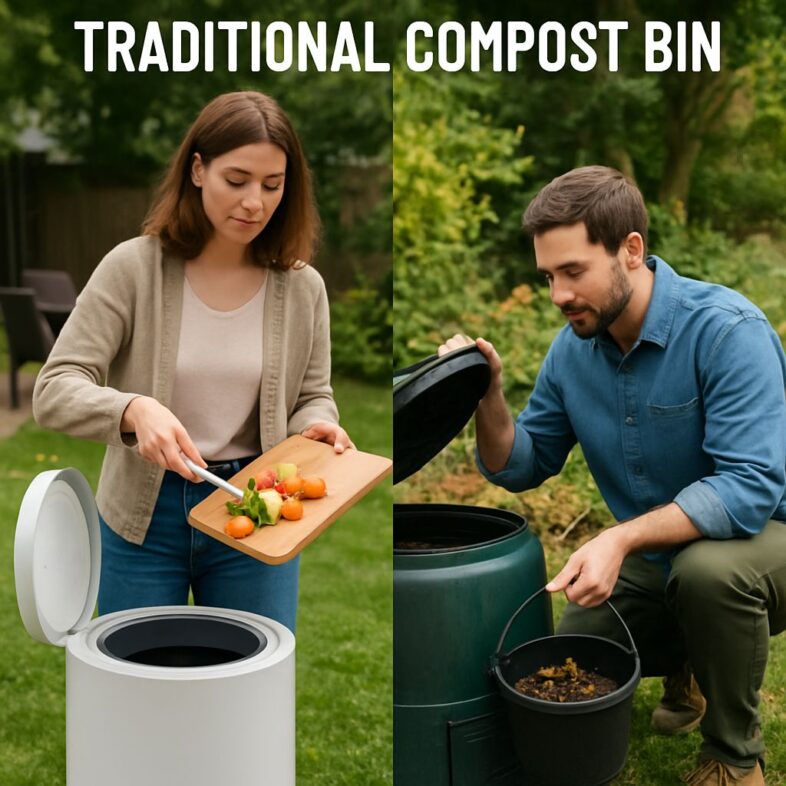
The main difference between these two composting methods is the speed at which they operate. A smart composter, such as the Lomi by Pela or the Reencle Prime, can process a batch of food waste in 24 to 48 hours using heat, aeration, and microbial activity. In contrast, a traditional outdoor bin, if left alone using a “fill and forget” method, takes 6 to 12 months. This is not a minor difference — it's a completely different composting approach.
However, speed isn't the be-all and end-all. Traditional bins can manage much larger quantities of food and garden waste, and the compost they produce usually has a higher microbial diversity. For anyone with a vegetable garden or a serious interest in soil health, that's more important than a quick turnaround.
Understanding Smart Composters
Smart composters are electric appliances that can sit on your countertop or stand alone, and they are designed to speed up the decomposition of food scraps indoors. Rather than relying on natural microbial activity and outdoor conditions, smart composters use a combination of heat, mechanical grinding, and controlled airflow, and in some models, live microbial cultures, to break down organic material in a fraction of the time it would take in a traditional compost pile.
Understanding the Functionality of Smart Composters
There are two common methods that most smart composters use. The first method is dehydration and grinding. This method, used by composters like the Lomi, heats the food waste to temperatures between 50–80°C, dries it, and then grinds it into a fine, soil-like material. The second method utilises live microbes. This method, used by composters like the Reencle, keeps a microbial ecosystem inside the composter that continuously breaks down the waste without having a defined cycle. Both of these methods are significantly faster than composting outside, but they function differently and produce different final products.
Typical Characteristics of Smart Composters
While smart composters can differ depending on the brand and cost, they usually have a basic set of attributes that make them suitable for indoor use. For those interested in the environmental impact of composting, understanding biogas problems and solutions can provide additional insights into how smart composters contribute to sustainable waste management.
- Odor Filtration — This is typically an activated carbon filter that neutralizes odors during processing
- Automatic Mixing/Grinding — These are rotating paddles or blades that break down food scraps evenly
- Temperature Control — This is an internal heating element that speeds up decomposition or dehydration
- Cycle Mode Selection — These are settings for different waste types or desired output consistency
- Compact Size — Most countertop units fit within a 30–40cm width, which is about the same size as a large blender or bread maker
What Can You Put in a Smart Composter and What Can't You Put in a Smart Composter?
Smart composters are usually more flexible than you might think. Most units accept fruit and vegetable scraps, coffee grounds, eggshells, cooked food, meat, and fish. The last two are a big advantage over traditional composting methods, which strongly discourage meat. But there are limits. Hard materials like large bones, shellfish shells, and pits from avocados or mangoes can damage the grinding mechanisms in dehydration-based models.
Too much liquid from foods like soup or dairy can create problems, especially in microbial units, because it messes with the moisture balance inside the bin. If there's too much moisture in the Reencle, for instance, you're supposed to add absorbent materials.
Understanding Traditional Compost Bins
Traditional composting involves letting organic waste naturally break down over time. This is usually done in an outdoor bin or an open pile. The process relies on creating the right environment for microorganisms, fungi, and invertebrates such as worms to decompose organic matter into humus. Humus is a dark, nutrient-rich substance that significantly enhances soil structure and fertility.
Composting Pile, Compost Tumbler, and Vermicomposting
Traditional composting isn’t a one-size-fits-all method. A composting pile is the simplest form, where waste is layered directly onto the ground and turned periodically to introduce oxygen. A compost tumbler, like the Lifetime 60309 Dual Compost Tumbler, is a rotating drum that’s enclosed, speeding up the composting process while keeping pests out. Vermicomposting uses red wiggler worms, typically Eisenia fetida, to process food waste in a worm bin, resulting in worm castings which are some of the most nutrient-rich soil amendments you can get.
What to Put in a Traditional Compost Bin
Traditional composting requires a balance of two types of materials: greens and browns. Greens, which include fruit scraps, vegetable peelings, grass clippings, and coffee grounds, provide nitrogen. Browns, such as cardboard, dry leaves, straw, and paper, provide carbon. The optimal carbon-to-nitrogen ratio is about 25–30:1 by weight.
What you don't put in is just as crucial. Open bins and tumblers generally steer clear of meat, fish, dairy, and cooked foods because they draw in pests and cause bad smells. Sick plants, anything that's been sprayed with pesticides, and pet waste should also be left out of a conventional home compost arrangement.
Comparing Smart Composters and Traditional Compost Bins: What Sets Them Apart?
Decomposition Speed
Smart composters have a clear advantage when it comes to speed. The Lomi by Pela, for instance, can complete a basic cycle in just 4 hours using its “Lomi Approved” mode, or up to 20 hours on its eco mode for a more thorough breakdown. The Reencle Prime operates nonstop, so the waste you add today could be ready within 24 hours. A traditional plastic compost bin, on the other hand, takes 6 to 12 months if you just fill it and forget it, or 3 to 6 months if you turn the pile every week or two. For those interested in understanding more about the process of organic waste decomposition, check out this anaerobic digestion guide.
Size Considerations
Smart composters are designed to fit in tight spaces. Most units designed for countertops take up about as much space as a kitchen stand mixer — for example, the Lomi measures 38cm in width by 30cm in depth, making it a practical choice for apartments, condos, and homes without access to outdoor space. You simply plug it in, fill it up, and it can sit on your countertop or be stored in a cabinet.
Traditional compost bins require outdoor space. A typical 220–330 litre plastic compost bin, such as the HOTBIN Mini, needs to be placed on the ground, either on soil or a hard surface, with enough room to turn the compost or access a hatch at the bottom to remove the compost. Compost tumblers, like the Lifetime 60309 Dual, require even more space and ideally should be placed in a sunny location to help keep the internal temperature above 40°C for quicker composting.
Initial Investment
If you're keeping an eye on your wallet, then traditional composting is the clear victor. A standard outdoor compost bin can be found for roughly $30–$60, and in the UK, Australia, and Canada, many local councils even offer further subsidies — occasionally bringing the price down to $10–$15. A mid-tier tumbler like the Envirocycle Original will set you back about $100–$150.
Smart composters are more expensive. The Lomi is priced at about $499 USD, the Reencle Prime at roughly $449 USD, and high-end models such as the Mill Food Recycler have a monthly subscription fee in addition to the cost of the hardware. Include replacement carbon filters, which typically need to be replaced every 3 to 4 months and cost around $15–$25 each, and the annual cost increases rapidly, especially when you consider the electricity usage.
Upkeep and Time Investment
While traditional composting requires a higher physical commitment, it is less of a financial burden. You will need to turn over the compost pile every 1 to 2 weeks, keep an eye on moisture levels, and consistently maintain a balance of green and brown materials. If the pile becomes too damp, too dry, or has too much nitrogen, decomposition will slow down and it will start to smell. It's not a difficult process, but it does require some care.
Smart composters change the game. The daily work is a breeze — just open the lid, toss in scraps, and press a button. However, they do need occasional filter replacements, periodic deep cleaning of the grinding chamber, and in microbial models like the Reencle, careful monitoring of moisture and what is put in to keep the microbial culture thriving. Neither method is completely free of maintenance.
Compost Quality
Now we're getting into the nitty-gritty. Dehydration-based smart composters like the Lomi produce an output that isn't really compost in the traditional sense. Instead, it's a dried, pre-composted material that needs to be mixed into the soil and left for a few more weeks before plants can fully utilize the nutrients. The humification process isn't complete, so it doesn't have the full microbial diversity of mature compost.
When you compost in the traditional way and do it right, you get real humus. This is biologically active, full of good microbes, and ready to use as a soil improver or mulch. Worm composting, in particular, often does better than most other methods in terms of nutrient richness. The worm casts are high in nitrogen, phosphorus, potassium, and plant growth hormones like auxins and cytokinins. If your main aim is to improve the health of your soil, traditional methods still have the edge.
Who Should Opt for a Smart Composter
If you live in a city, rent an apartment, or don't have reliable outdoor access, a smart composter is the perfect solution for you. If you produce about 1–2 kg of kitchen waste per week and your main objective is to keep that food out of landfill rather than producing a lot of garden compost, a smart composter is a great fit. The speed, the odor control, and the convenience of having it indoors are real problem solvers for this group.
Furthermore, smart composters are a great option for homes that produce food waste that traditional composting methods struggle with, such as cooked food, small quantities of meat and fish, or dairy products. Instead of automatically sending these materials to a landfill, a smart composter provides a useful and sanitary solution for all types of kitchen waste.
Who Should Keep Using a Traditional Compost Bin
For those with a garden, outdoor area, and a steady flow of food and garden waste, traditional composting remains the more efficient and economical option. The sheer volume capacity — most outdoor bins can accommodate 200–400 litres, while a typical smart composter has a 3–4 litre chamber — makes traditional methods far more suitable for households with larger composting requirements. For those interested in alternative waste management processes, exploring the biogas production process might provide valuable insights.
Optimal Conditions for Successful Traditional Composting
Traditional composting works best when you have a steady supply of both green and brown materials, outdoor temperatures that remain above freezing for the majority of the year, and sufficient space to position a bin away from the house to reduce potential smell issues. A sunny or partially shaded location aids in maintaining the internal pile temperatures, which ideally should reach 55–65°C during the active phase to rapidly decompose material and eliminate weed seeds.
When Saving Money Is Worth the Extra Effort
If you're trying to save money, the decision is easy. You can get a subsidised outdoor bin for $15–$30 and put in a year's worth of work, or you can pay $450–$500 for a smart composter. The outdoor bin will also give you more and better soil. If you have the space and the time, it's hard to say no to that.
One point to consider is that traditional composting can handle a larger volume than smart composters. If you're a serious gardener, keep chickens, or have a small plot, you'll quickly outgrow a countertop device. Two or three traditional bins can handle the amount that would require running a smart composter several times a day, every day. This is neither practical nor energy-efficient.
Which Composting Method Is More Environmentally Friendly?
Both composting methods are far superior to sending food waste to the landfill, where organic materials break down without oxygen and produce methane. Methane is a greenhouse gas that is approximately 80 times more potent than CO₂ over two decades. However, comparing the environmental impact of smart composters and traditional compost bins is more complicated than it seems. The answer largely depends on how each composting method is powered and utilized.
How Much Energy Do Smart Composters Use?
Smart composters are powered by electricity, and that's a factor to consider when you're thinking about their environmental impact. The Lomi by Pela uses about 1 kWh of electricity per cycle in its standard mode, which is about the same as running your dishwasher one time. If you use it every day or every other day, that could add up to between 180 and 365 kWh per year. Whether that's a problem for the environment depends on where your electricity comes from. If your area uses mostly renewable energy, the impact is small. But if your area uses a lot of coal for electricity, the carbon emissions from using a smart composter every day could be a concern.
Composting machines like the Reencle Prime, which uses microbes to break down waste, are typically more energy-efficient per cycle because they don’t rely on high heat. They tend to use around 70–100W while actively processing waste. However, because these machines run continuously instead of in specific cycles, they can use just as much energy over the course of a year as machines that use dehydration. The environmental impact isn’t as clear-cut as the marketing might lead you to believe.
Environmental Impact of Both Approaches
When you compost the old-fashioned way, outside and without using any electricity, it has a very low carbon footprint while it’s being used. The main gases it gives off are nitrous oxide (N₂O), which is created during the breakdown process, and methane, which can be created if the pile is not aerated enough and has too much water. When you turn it enough and control the moisture, it gives off very little of these gases, and the benefit of using the finished compost in soil makes up for a lot of it.
Smart composters can process waste quickly and aerobically, which eliminates the risk of N₂O and methane emissions. However, they use electricity, which traditional compost bins do not. So, which is better for the environment? Both methods are far better than landfill. But if used correctly, traditional composting has a smaller environmental footprint. However, for households without a garden, a smart composter is still a good choice for the climate, especially if it is powered by renewable energy.
Final Thoughts: Which Is Better for Home Use
There is no definitive answer to this question — and anyone who tells you there is, is not looking at the whole picture. Smart composters are genuinely a game-changer for urban households, renters, and anyone without access to a garden. They solve the food waste problem in a quick, clean manner, without requiring outdoor space or a deep understanding of the science behind composting. Traditional bins remain the superior choice in terms of volume, compost quality, cost-efficiency, and overall environmental performance — but only if you have the space, the time, and a use for the end product. The right answer is the one that actually suits your lifestyle, because a composting method you use consistently will always be more effective than one that sits unused because it's too complicated or too inconvenient.
Common Questions
Can I use a smart composter instead of a traditional compost bin?
If you live in an apartment or don't have a yard, a smart composter can be a complete replacement for a traditional compost bin. However, if you have a garden and need large amounts of high-quality compost to use in your soil, a smart composter won't be enough. The amount it produces is too small, and the compost often needs to be cured outside before it can be used as real compost. Many gardeners use both a smart composter and a traditional compost bin: the smart composter for cooked food and meat, and the traditional bin for garden waste and raw vegetable scraps.
What is the timeline for a smart composter to produce compost that can be used?
The timeline can vary depending on the type of smart composter and what you consider to be “usable” compost. For example, a dehydration-based composter like the Lomi can complete a cycle in 4 to 20 hours, but the dried material it produces needs to be mixed into the soil and left for 2 to 4 weeks before plants can fully access the nutrients. On the other hand, a microbial composter like the Reencle Prime processes waste continuously, and the material is typically ready to use within 24 hours of the last addition. However, it functions more as a compost activator than a finished soil amendment. Neither of these options delivers the fully matured humus that a well-managed outdoor bin can produce over several months.
Do smart composters stink?
Not usually. Most smart composters employ activated carbon filters to manage smells during the composting process. If you use them properly, which means not overstuffing the machine or adding too much liquid, they shouldn't smell. Many users have noted that the Lomi is particularly good at managing smells during its grinding and heating phases. For those interested in alternative methods of waste management, you might find this comparison of digesters for livestock insightful.
However, filters do wear down and need to be replaced every three to four months, depending on how often you use them. In most smart composter reviews, a worn-out filter is the most common reason for complaints about bad smells. If you put in the wrong things or too much moisture, the bacterial balance inside microbial units like the Reencle can get thrown off, which can also cause bad smells. You do have to pay attention to what you're putting in and how much.
Should I still compost the traditional way if I garden?
Without a doubt. Traditional composting is one of the most beneficial sustainable habits a gardener can adopt. The end product of composting improves the structure of the soil, increases the soil's ability to retain water, introduces beneficial microorganisms, and reduces the need for synthetic fertilizers. Vermicompost, in particular, produces castings that are extremely rich in nutrients that are readily available to plants. The time commitment of turning a compost pile every week or two is well worth it. The increase in garden productivity that results from composting is something that no store-bought soil amendment can fully match. Plus, once the bin is set up, composting costs next to nothing.
Is it worth it to spend more on a smart composter?
For some people, the answer is yes. If you're currently throwing all your food waste — including cooked food, meat scraps, and dairy — directly into the garbage because you don't have an outdoor composting option, a smart composter priced between $450 and $500 is a significant and justified investment in reducing your environmental footprint. The convenience is undeniable, and it's much easier to use on a daily basis than outdoor methods, which often involve biogas production processes.
Those who already have an outdoor composting system and mostly compost raw fruit and vegetable scraps may not find the benefits as compelling. The cost is much higher for a slight increase in convenience, and the compost quality you get from an outdoor bin, especially a hot compost setup or a worm bin, is genuinely better than what you get from a countertop appliance.
It's also important to think about the long-term costs. You'll have to factor in the cost of replacement carbon filters, the electricity it uses, and the cost of replacing the unit itself (most smart composters are expected to last 3 to 5 years). All of this means that the total cost of owning a smart composter over a decade can easily be $800 to $1,200 or more. A traditional compost bin, on the other hand, can last 10 to 20 years with very little additional cost.
When it comes to composting at home, there are two main options: smart composters and traditional compost bins. Both have their pros and cons, and the best choice for you will depend on your specific needs and circumstances.
Smart composters are high-tech devices that speed up the composting process using heat and aeration. They can turn food scraps into compost in as little as 24 hours, and they're generally easy to use. However, they can be quite expensive, and they require electricity to operate. For more information on these devices, check out this guide on electric composters.
Traditional compost bins, on the other hand, are much simpler and cheaper. They don't require electricity, and they can handle a wider range of materials, including yard waste. However, they take longer to produce compost (usually several months), and they require more work to maintain.
So, which is better for home use? It really depends on your situation. If you want compost fast and don't mind spending more money, a smart composter might be the best choice. But if you're on a budget and don't mind waiting, a traditional compost bin could be a better option.








 Verified by